Progress on access to Australian Standards
Better and more affordable access to standards has been a longstanding advocacy priority for the ACA – and for me personally. We have consistently argued that architects and other built environment professionals should be able to access relevant standards reasonably and affordably, ideally at no cost.
We have pursued this through our direct advocacy with government and Standards Australia, as well as through the broader industry campaign led by the Australian Construction Industry Forum (ACIF).
So, we were very pleased to see the Australian Government commit to funding access to standards referenced in legislation.
There is still plenty to work through, particularly around how the new arrangements will operate in practice. So, on behalf of the ACA, I reached out to Rod Balding, CEO of Standards Australia, to congratulate him and his team, and to arrange a meeting to discuss how the new arrangements will operate in practice. With my ACIF Board Director hat on, I invited him to a meeting with ACIF to discuss some of the questions we are hearing from businesses and our members across the built environment.
Here is a summary of that important meeting, which was also published by ACIF in its recent Industry E-News.
From advocacy to implementation
Standards Australia confirmed that the new Government-sponsored model is expected to provide read-only digital access to standards referenced in Commonwealth, state and territory legislation.
Rod acknowledged that the Government’s decision followed sustained advocacy from Standards Australia and industry associations, like the ACA. It is encouraging to see an issue the ACA has pursued for some time now moving towards implementation.
There is still work underway before the new arrangements commence. One of the challenges is identifying the complete list of standards referenced across different jurisdictions. As Standards Australia does not automatically get notified when a standard is picked up in legislation, they are working with governments and industry on the processes required to implement the new model.
We also emphasised the need for greater visibility around timing. Members understandably want to know when the new arrangements will be available and will continue to keep on top of this.
Making sure it works for practices
A key focus for the ACA has always been the practical usability of standards. Free access is a very welcome development, but the model also needs to reflect the way architects actually use standards in their day-to-day work.
One issue we raised was cross-referencing between standards. A standard referenced in legislation may itself refer to other standards that a practitioner needs in order to properly understand and apply its requirements. Those interdependencies need to be considered as the scope of the new access arrangements is determined. Free access to a mandatory standard is of limited use if the standards it relies upon remain behind a paywall.
We also asked about the practicalities of working across several standards at once. Standards Australia confirmed that users will be able to have multiple standards open simultaneously, allowing practitioners to move between and cross-reference them as they work.
We also discussed search functionality, bookmarking and access for multiple people within a practice. These may sound like small details, but they will make a considerable difference to how useful the new model is in practice.
We also raised the question of existing subscriptions.
Standards Australia advised that it is developing a framework to consider a pro-rata refund policy for subscribers who may decide they no longer require their existing subscription once Government-sponsored access becomes available.
The sponsored model will have different functionality from a paid subscription, so practices will need to consider whether the additional features of their existing subscription remain useful to them.
Standards and AI
We also had a very interesting discussion about where Standards Australia sees AI fitting into the future.
Standards Australia is exploring the longer-term potential of how AI could be used to make standards content more accessible, searchable and easier to navigate. This could eventually make it easier to ask questions in plain English, find relevant provisions, navigate technical information and calculations, and potentially translate information.
For me, this is an area the ACA needs to stay close to.
AI is already finding its way into architectural practice, and access to reliable source material will become increasingly important. If practitioners are using AI to help navigate technical and regulatory information, they need confidence that the answers are drawing on current and authoritative standards.
There are clearly issues around accuracy, risk and appropriate professional judgement to work through, and Standards Australia was very conscious of these in our discussion.
Where to from here?
One of the most useful outcomes of the meeting was Standards Australia’s willingness to develop a closer relationship with the organisations representing the people who use standards every day.
ACIF has offered to provide a conduit between Standards Australia and ACIF member organisations, particularly as the new arrangements are rolled out and practical issues begin to emerge.
Rod also offered to meet directly with ACIF’s individual member associations, and I intend to take him up on that offer on behalf of the ACA.
This will give us the opportunity to focus specifically on architectural practice – which standards our members rely on, how they use them, where access remains difficult, and what could make the system work better.
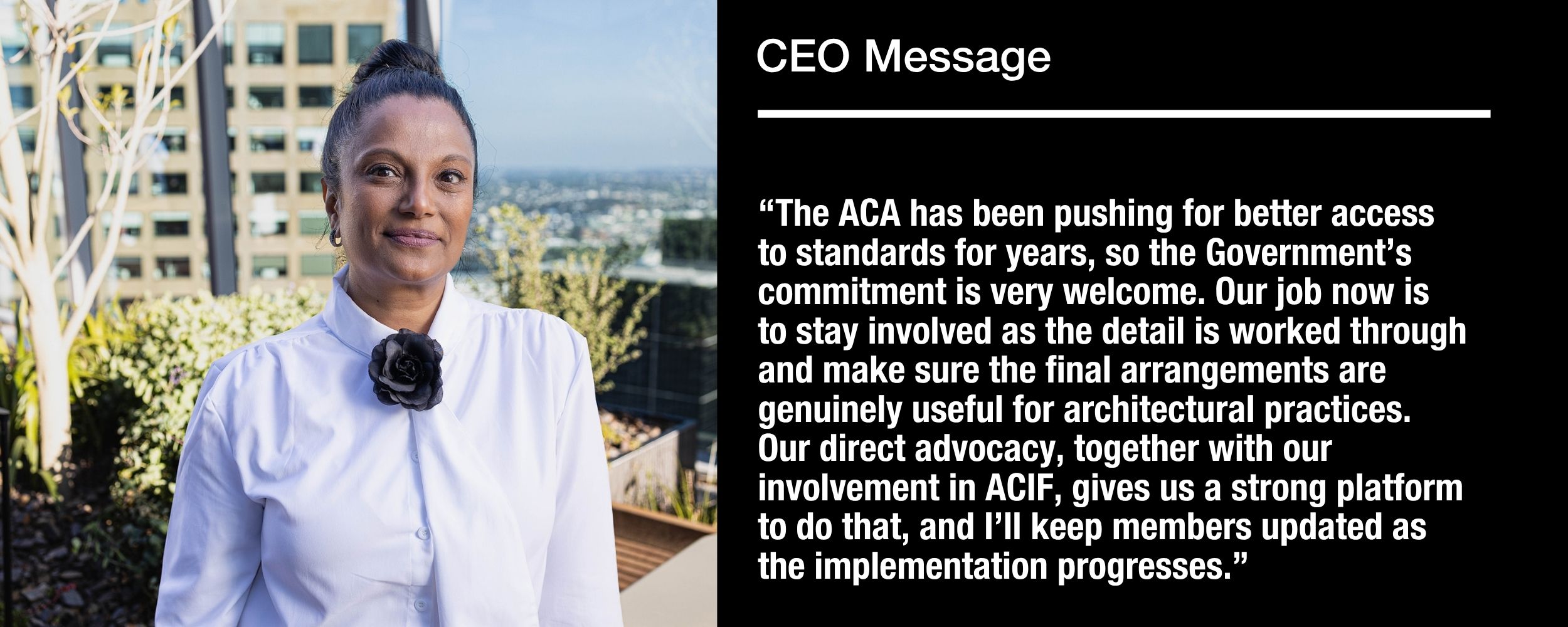
The ACA has been pushing for better access to standards for years, so the Government’s commitment is very welcome. Our job now is to stay involved as the detail is worked through and make sure the final arrangements are genuinely useful for architectural practices.
Our direct advocacy, together with our involvement in ACIF, gives us a strong platform to do that, and I’ll keep members updated as the implementation progresses.
But for now, this is the news we’ve all been waiting for.
Head here to read the ACIF Industry E-News.