Projects, people & personal values
What leadership approach has served you best in practice, and how has it evolved over time?
Matthews & Scavalli Architects was established in 1999. The approach from the inception was to work with clients on projects that align with personal values, and understand that working life and family can co-exist, with special family events and priorities coming first. Matthews & Scavalli has always sought to offer flexible work arrangements, working-from-home options and an approach to office life that is realistic regarding workloads and expectations. We highly value all our staff. These are the people you see almost every day.
What’s one thing you wish you’d known earlier in your career?
Back yourself! Do the homework and have confidence in your point of view. The architecture degree is challenging and you have successfully passed that. Then the registration process is an additional round of informative but demanding education. Working in an office is a daily process of ‘thinking outside the box’ and problem solving. If you have made it this far, you definitely know something and should back yourself.
Who have been the key influences or mentors in your career, and what did they teach you?
I graduated from Curtin University in 1995 and joined the workforce soon afterwards, working in a number of offices during the 90s. There was a recession during that early period, so work for new graduates was tenuous. This process of changing offices regularly due to drops in workload, did benefit me. I had the opportunity to work in a range of established practices across a number of building types in large commercial firms, smaller one- and two-person offices, as well as over east. The chance to work with a range of architects who were mostly all helpful and encouraging to the new grad was a great influence on my career. I got to experience different practice styles, different office cultures and different leadership approaches, and learned from the good and the bad experiences.
What change would you most like to see in the industry over the next decade?
I would like to see an integrated and measured approach to digital technologies use. Digital tools are powerful options to improve productivity, but the rates of change of the platforms, forever increasing subscriptions rates and the proliferation of program options is a distraction to the core role of architects.
Architects are in the position to influence the urban and built experience for people. Architects need to remain involved and mindful of the human experience. The absorbing qualities of the digital tools can take architects further and further away from a cultural understanding. The speed of digital change can be alienating to large sectors of the architectural profession and be a cause of division rather than a useful tool to improve the architectural process.
What motivated you to volunteer on an ACA Committee, and why does contributing to the collective work of the profession matter to you?
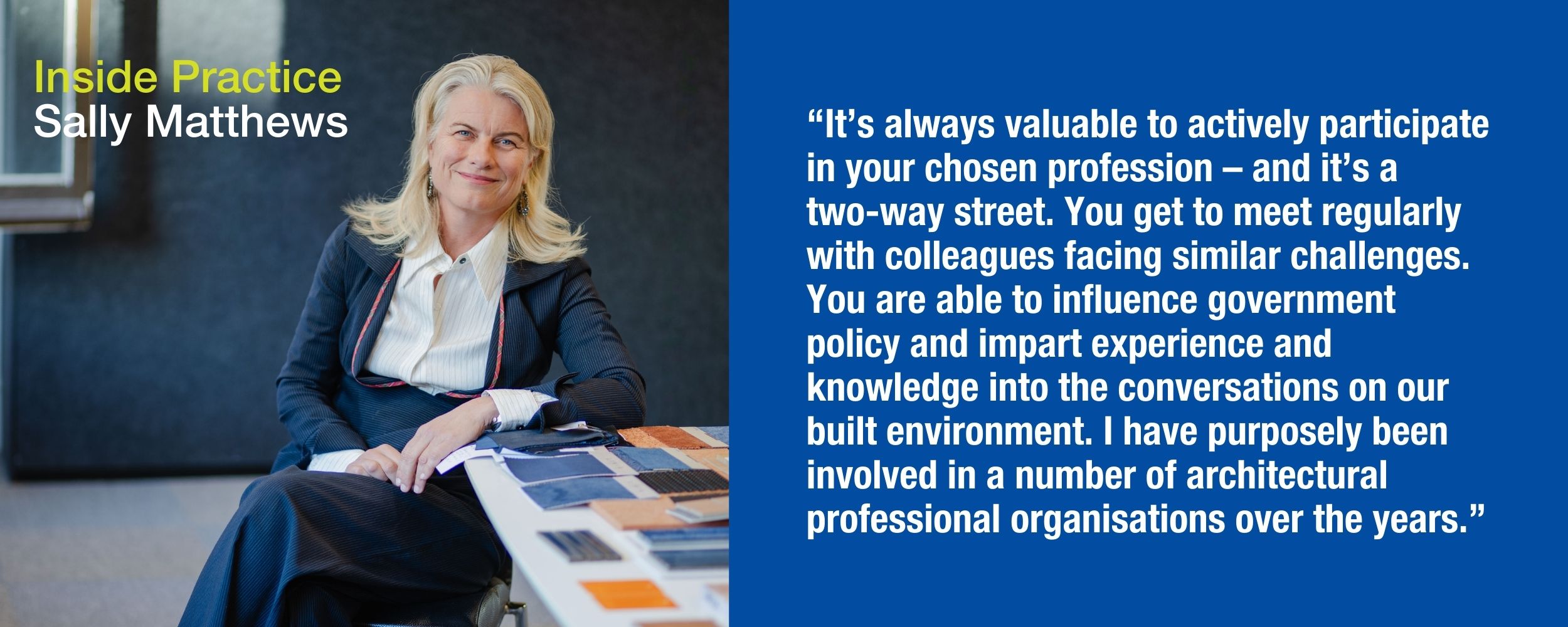
It’s always valuable to actively participate in your chosen profession – and it’s a two-way street. You get to meet regularly with colleagues facing similar challenges. You are able to influence government policy and impart experience and knowledge into the conversations on our built environment. I have purposely been involved in a number of architectural professional organisations over the years, such as RAIA chapter Council and Juror, AACA University accreditations, WA Architects Board examiner and exam convenor, and now the ACA, who are a motivated, effective and informed group of professionals.
Sally is a founding director of Matthews and Scavalli Architects in Fremantle. She has over 25 years of experience in the architectural industry, from within her own company and with a number of leading architectural companies in Perth and Brisbane.