
What sets architects apart?
As debate continues regarding the future of the Architects Registration Board of Victoria (ARBV), the proposed Architects Regulations and Code of Conduct, and the broader question of how architects should be regulated in Victoria, it is worth stepping back and asking a more fundamental question: What is it that actually sets architects apart?
The answer is often assumed to be our qualifications.
Certainly, architects undertake extensive education, practical experience and examination before being eligible for registration. We are trained differently from other building designers. We learn to balance creativity and technical knowledge. We work across disciplines and consider complex and often competing demands.
These things are important. But qualifications alone do not define a profession. Nor do they fully explain why architects are granted the privilege of registration and the trust that accompanies it.
What distinguishes architects is that our responsibilities extend beyond the interests of our clients. Unlike many service providers, architects are expected to consider broader obligations to society. We have responsibilities not only to those who engage us, but also to building occupants, neighbours, communities, future generations and the public.
We are expected to consider health and safety.
We are expected to consider accessibility and inclusion.
We are expected to act ethically and honestly.
We are expected to consider environmental sustainability, cultural values and the long-term impact of the built environment.
At times, those responsibilities require professional judgement that extends beyond a client’s immediate objectives or commercial interests. That public duty is one of the defining characteristics of our profession.
Importantly, these responsibilities are not simply ideals. They are expressed through the legislation, regulations and codes that govern professional practice. This is why the current discussion about the Regulations and Code of Conduct is so important.
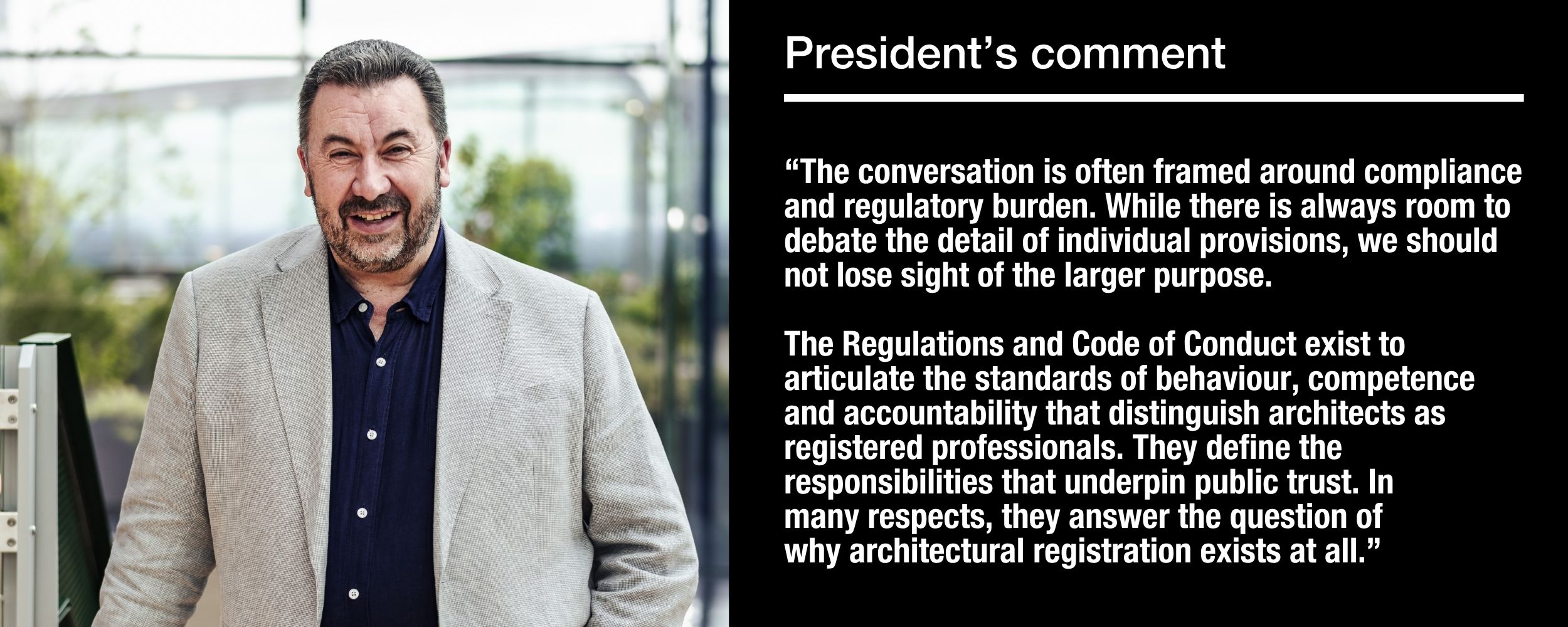
The conversation is often framed around compliance and regulatory burden. While there is always room to debate the detail of individual provisions, we should not lose sight of the larger purpose.
The Regulations and Code of Conduct exist to articulate the standards of behaviour, competence and accountability that distinguish architects as registered professionals. They define the responsibilities that underpin public trust. In many respects, they answer the question of why architectural registration exists at all.
This is also why the debate surrounding the future of the ARBV matters.
The profession has understandably expressed concern about proposals that could abolish the ARBV and transfer its functions to a larger licensing authority. Architectural practice is not simply another form of business licensing. It is a profession with distinct obligations and responsibilities that require specialist understanding and oversight.
The expertise developed within a dedicated architectural regulator has been built over decades through experience, complaint handling, disciplinary processes and engagement with the profession and the community. At a time when that specialist regulatory framework may be under threat, we must clearly articulate why it exists.
This is why I was encouraged to see almost 2,000 people support the petition tabled in the Victorian Parliament by David Southwick MP, calling for the functions performed by the ARBV to be maintained irrespective of where they ultimately sit within government.
That petition recognised an important principle – that architectural registration serves an important public purpose and that the functions supporting that purpose should not be diminished.
As a profession, we should continue to engage constructively in discussions about regulatory reform. We should advocate for regulations that are clear, proportionate and practical. We should identify unintended consequences and work collaboratively to improve outcomes.
But we should also remember that the Regulations and Code of Conduct are more than a set of rules. They express the professional obligations that distinguish architects from other design practitioners.
Ultimately, what sets architects apart is not simply what we know. It is not merely the qualifications we hold. It is the responsibilities we accept – social, environmental, cultural, ethical and professional.
And they remain one of the strongest justifications for maintaining a robust system of architectural registration and specialist regulation in Victoria.