Advocacy update – March 2026
Last November I wrote about our visit to Parliament House, representing the ACA through the Australian Construction Industry Forum (ACIF), highlighting the importance of making architecture visible not just as a profession, but as a business sector that underpins national priorities – housing delivery, productivity, sustainability and economic growth.
Since then, we have taken the next step. Over the past month, Kukame McPierzie and I have written directly to eight Federal Ministers whose portfolios intersect with architectural practice. Each letter focused on specific, practical issues affecting members.
Encouragingly, the response has been immediate.
Follow-up meetings with Ministerial offices and government departments have already taken place across February, and are scheduled for March.
WHAT WE ARE RAISING
Rather than a single architectural issue, our approach has been to position practice as connected to these broader government objectives:
1. Housing delivery
Delays often occur well before construction begins. Inefficient briefing, procurement duplication and compliance complexity slow projects long before a shovel reaches the ground. Improving these processes is one of the fastest ways to increase housing supply without reducing standards.
Our recent response to the NSW Housing Supply Review reinforced that increasing supply is not simply about faster approvals. It requires freeing up industry capacity, streamlining development pathways and improving the design review process while maintaining quality benchmarks. It also means enabling innovation, including modern methods of construction such as prefabrication, which rely on clear documentation, coordinated regulation and early design resolution. When processes are poorly aligned, projects stall in assessment and redesign rather than delivery, and new construction approaches become harder to implement. Addressing these system inefficiencies can materially increase housing output without compromising liveability or design quality.
2. Productivity, skills and workforce
We are highlighting the invisible productivity cost embedded in the way architectural work is delivered, particularly the significant time practices spend training graduates to bridge the gap between education and competency. Architecture practices are effectively running a parallel training system to ensure competent practitioners. We are asking government to recognise this as workforce development infrastructure. Every hour a practice spends bringing graduates to competency is necessary, but it’s an hour not spent delivering projects. That’s a measurable productivity cost, yet it sits almost invisibly inside business overheads rather than national productivity data.
Emma Brain, our national policy and advocacy lead, and I have also lodged our submission to the Select Committee on Productivity in Australia – Parliament of Australia.
3. Business sustainability
Architecture practices are overwhelmingly small businesses, yet many carry disproportionate contractual risk while also facing delayed and uncertain payment pathways. In effect, practices are required to finance projects while retaining full professional liability. This combination of cash-flow exposure and uninsurable risk discourages participation, particularly in public projects, and steadily reduces industry capacity. Strengthening security of payment is therefore not simply a contractual issue; it is a delivery issue affecting the viability of firms needed to deliver housing, infrastructure and community facilities. A recent example in South Australia, where 15-day government payment terms improved small business participation, demonstrates how policy settings can directly influence capacity.
4. Standards and compliance
We are continuing to advocate for improved access to Australian Standards. Architects are legally required to comply with these documents, yet they remain locked behind paywalls and licensed in ways that require repeated purchase across teams and projects. This places the cost of meeting regulatory obligations onto individual businesses rather than treating compliance as shared national infrastructure.
The impact is not only financial. When essential technical requirements are fragmented across purchased documents, teams spend significant time locating, verifying and cross-checking rules rather than progressing work. Improving access to Standards is therefore not about convenience; it is about safer documentation, reduced risk, and faster project delivery across the entire construction system. It also points to the productivity issue.
In recent discussions with Federal Ministers, there has been a request for a clear ‘business case’ outlining the real cost of compliance where regulatory materials are not readily accessible. The ACA is leading this work in partnership with ACIF, recognising that this issue affects all in the built environment, and is not confined to architecture.
This also connects directly to our submission on the Modernisation of the National Construction Code (NCC). Where Standards are incorporated by reference into the NCC, they effectively become part of the regulatory framework.
Australian Standards referenced in the NCC should therefore be freely accessible, or available at minimal cost. Compliance with the law should not depend on the ability to pay to access it.
WHY THIS MATTERS
Architectural businesses are part of the delivery system for government priorities. If practice conditions are inefficient, project delivery is inefficient. Then what happens? Housing slows and capacity shrinks.
The solution? Improving the business environment for architects improves productivity and project certainty across the whole construction system.
That is why this conversation is gradually gaining traction, because we are talking about delivery capability, not just professional representation.
COLLABORATIVE ADVOCACY
I’ve often lamented that our industry is too small for us to operate independently in silos. We need to harness the power of collective agency to break down professional boundaries and maximise our impact. That’s why we are pleased to announce a formal advocacy agreement with Consult Australia, strengthening a long-standing collaboration between our two business-focused organisations. The agreement establishes a clear, shared framework for advocacy, with aligned priorities, shared member insights and a focus on practical, business-led solutions. The industry benefits because we are stronger together.
WHAT HAPPENS NEXT
Over the coming months we will:
- continue to meet with Ministerial offices and departments
- test policy ideas with government advisors
- identify quick wins as well as longer-term reform opportunities
- bring members into consultation as proposals develop
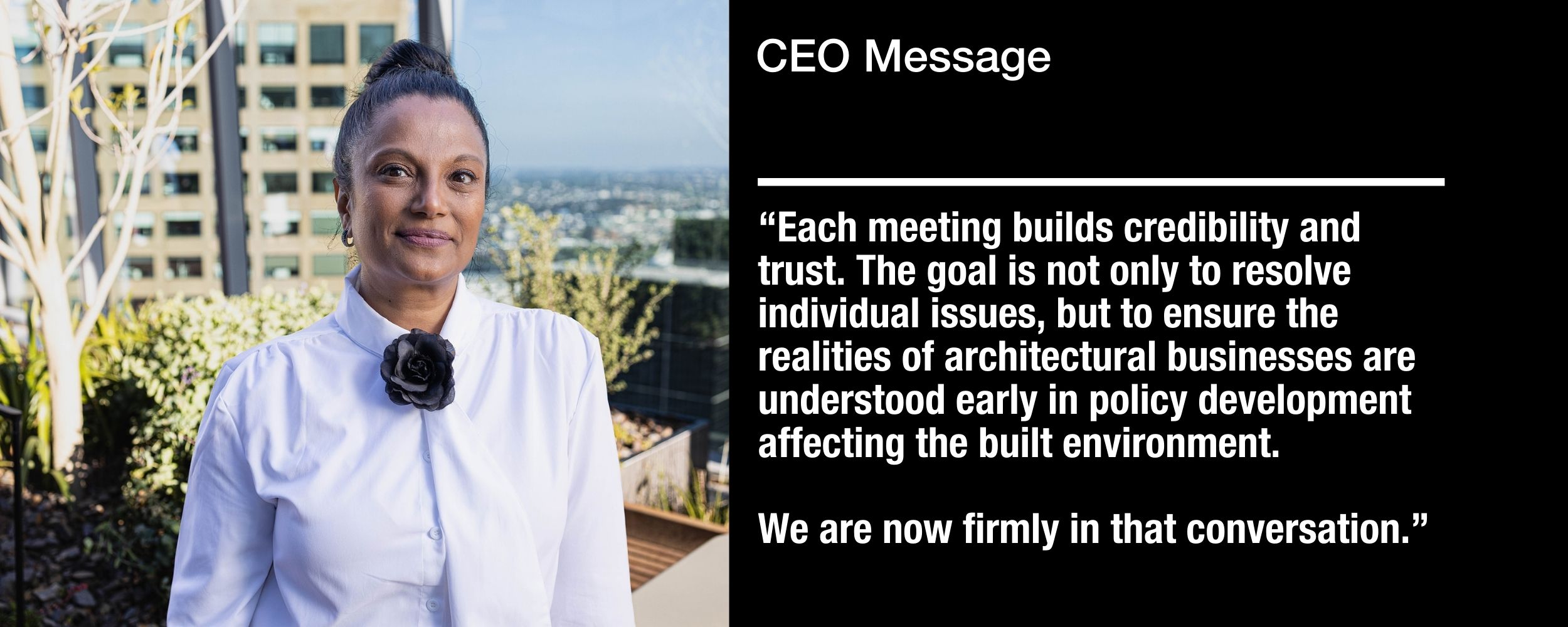
Each meeting builds credibility and trust. The goal is not only to resolve individual issues, but to ensure the realities of architectural businesses are understood early in policy development affecting the built environment.
We are now firmly in that conversation.