AI, policy & better business practices
Immediate past National President John Held highlights two critical priorities related to AI in architecture practice: the need for deep understanding and guidance of AI use within practice workflows; and the need for advocacy for better procurement methods, business conditions and acknowledgement of IP ownership at a time of rapid change.
“Mum! This is the best food I’ve tasted for ages!”, said the teenager in the Sydney Airport arrivals lounge after disembarking from an LA flight. Having spent two months on the road in the USA, we could identify with him and wanted nothing more than a home-cooked meal.
It’s often how I feel about AI: its content is like fast food – quick, convenient and not very healthy. No wonder so much of the content I see on social media is labelled AI slop. Like the trend back to home cooking and healthy eating, we are more aware of the dangers of consuming that slop.
Since last writing about AI a year ago, I can sense a mood shift and a more nuanced approach to AI – less “this will fix all our problems” or “we’ll all be ruined” and a more nuanced consideration of ethics, environmental and energy impacts, theft of intellectual property, and the risks and liabilities that come with widespread adoption of AI systems. Economists are now doing their sums and warning that the money spent investing in data centres doesn’t make sense: is a crash coming, or is AI usage going to be prohibitively expensive once the AI providers have hooked you into using their systems?
The recent statements by Prime Minister Albanese on AI suggest the government is aware of many of the issues. Acknowledgement of the importance of Australian creative workers as well as the social licence for overseas AI companies to work and build data centres here is encouraging. While centralised control might help the big picture, can it comprehend the thousands of little pictures that emerge as our patterns of work change?
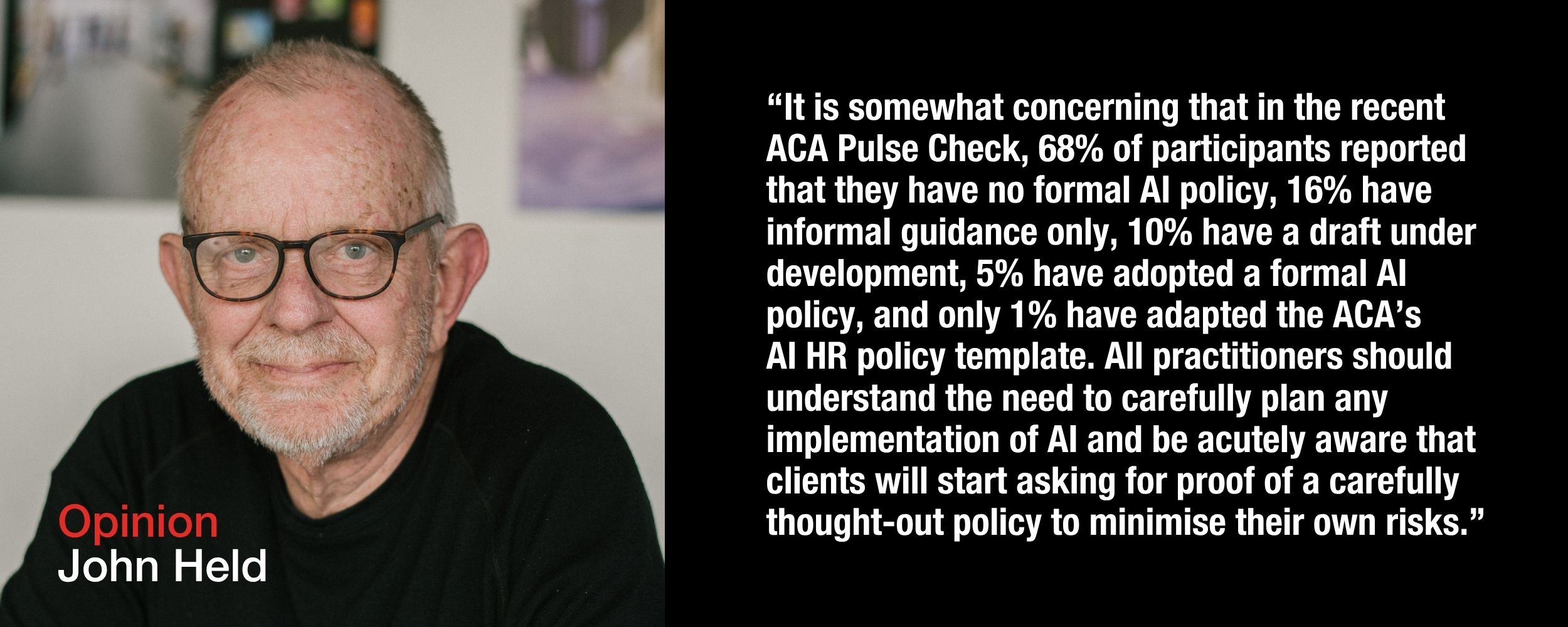
For architects, there are two critical priorities. One is understanding and guiding the use of AI within their workflows and those of their clients, consultants and end users. It is somewhat concerning that in the 2026 ACA Pulse Check, 68% of participants have no formal AI policy; 16% have informal guidance only; 10% have a draft under development; 5% have adopted a formal AI policy; and only 1% have adapted the ACA’s AI HR policy template. All practitioners should understand the need to carefully plan any implementation of AI and be acutely aware that clients will start asking for proof of a carefully thought-out policy to minimise their own risks. Architects also need to ensure their contracts with clients and subconsultants reflect the best practice of the ACA HR template and declare when and for what purposes AI is used, which will require a general update of consultancy agreements. That’s before practices consider the staffing, environmental, energy and economic impacts of the use of AI.
The second immediate priority is to take advantage of the national conversation to advocate for the things architects always say they want improved. “AI” and “productivity” are the political buzzwords of the moment, but can the need to update procurement methodologies to suit the new realities of AI be the spark for a wholesale look at the relationship between procurement, productivity, risk, environment and ownership of intellectual property? If the Prime Minister is keen to acknowledge the need for creatives to control copyright and moral rights, will those ownership rights be acknowledged in consultancy contracts? How can the relentless pressure to tighten timelines be resisted if computers rather than people are doing much of the work?
ACA’s advocacy recognises that technology alone won’t solve productivity, but better business practices will. This includes everything from procurement reform, unfair contracts, mental wellbeing, timelines, and risk allocation to the most important thing: professional judgment. AI might assist, but cannot replace, that professional judgement.
ACA is working with many other construction groups to navigate this new landscape. A healthy industry needs a well-balanced diet of careful policy and planning, not a rushed meal of slop. We need to find that recipe, and quickly.