
Breaking down barriers
What business achievement are you most proud of, and why?
For a long time, ‘business’ felt like a dirty word to me – a remnant of the ’80s yuppie culture that I wanted no part of. I spent years feeling like a failure because I couldn’t reconcile my mission with the need for profit. It took working with a business mentor to realise that balancing self-worth and business rigour is what actually fuels my mission. Once that clicked, I worked hard to obtain a scholarship for the Passivhaus certification course; seeing my paper win that placement was a massive proud moment because I’d never backed myself like that before. Similarly, being a finalist in the 2024 National Biophilic Design Awards – the only award I’ve ever entered — was a powerful validation that my ‘alternative’ approach to practice actually has a place at the top of the industry.
What’s one thing you wish you’d known earlier in your career?
That the ‘non-linear’ path is a superpower. I used to worry that starting my degree after having children put me behind. In reality, that period built the resilience and empathy I need to design effectively for the vulnerable families I serve today in social housing and women’s refuges. The ‘juggle’ is actually where the best leadership skills are forged.
What challenge has most shaped the way you lead or run a practice today?
A few years ago, after a tumultuous quarter and feeling totally burnt out, I realised my leadership style was stalling. Having been a mother for most of my life, I became aware I was ‘parenting’ my team rather than leading the business – and frankly, neither the team nor the profit analysis liked that. Over a Christmas break, I decided to leave that version of myself behind. I needed to put my ‘big girl pants’ on. And I did. The team changed, the profit changed, and order replaced the chaos. It taught me that while empathy is vital, professional clarity and business rigour are the true foundations of a sustainable practice.
Have you ever challenged established norms in architectural business culture?
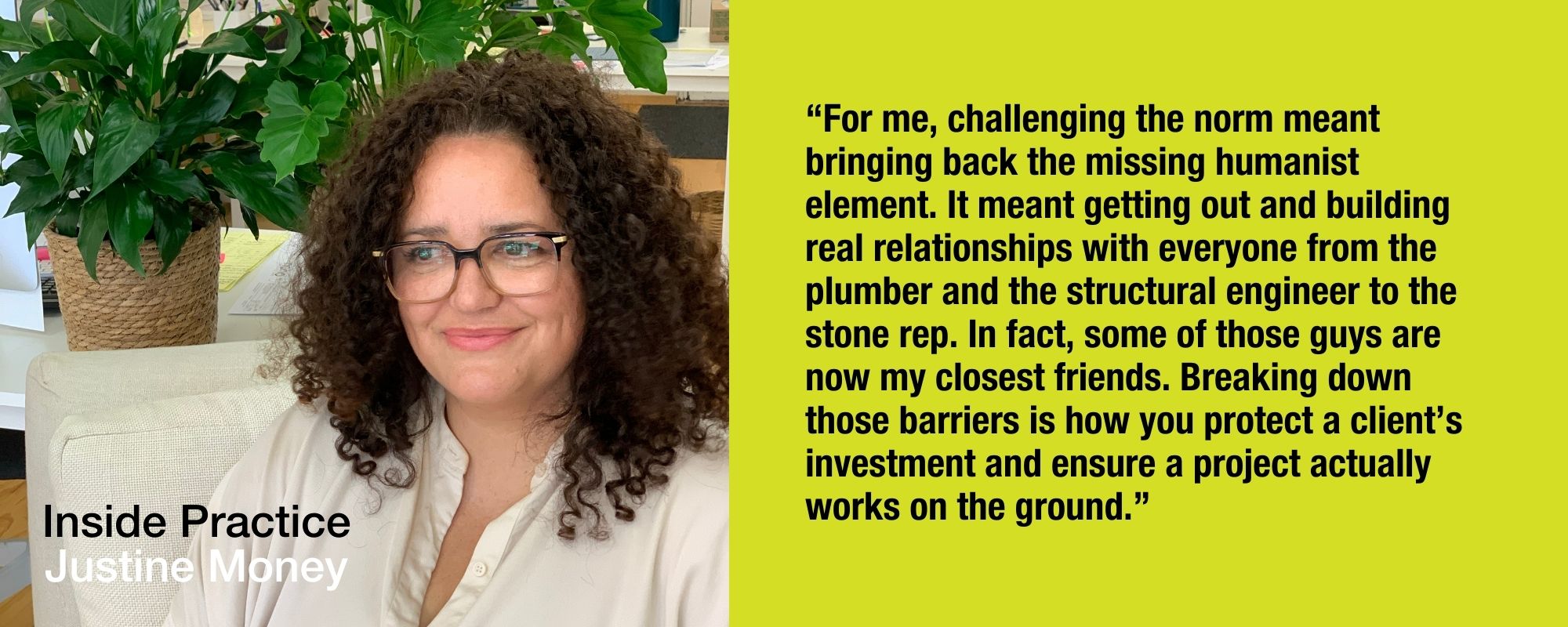
I will never stop challenging the norms of this profession; it can be so elitist, often with a healthy sprinkle of ego on top. I was determined to run a business differently – that was my own sprinkle of ego right there – and I have no doubt many architects in small practice share that sentiment. For me, challenging the norm meant bringing back the missing humanist element. It meant getting out and building real relationships with everyone from the plumber and the structural engineer to the stone rep. In fact, some of those guys are now my closest friends. Breaking down those barriers is how you protect a client’s investment and ensure a project actually works on the ground.
Who have been the key influences or mentors in your career?
My leadership is deeply rooted in the legacy of my great-grandmother, Atareta Thompson Poananga, and her cousin, the prominent leader John Mason Durie. Together, they led the Raukawa Tribal Executive in a radical decade-long effort to fund and build the Māori Battalion Hall (Te Rau o te Aroha) in Palmerston North. A trailblazer, Atareta was one of the first Māori women to earn a commerce degree abroad (at the University of Utah), returning with the technical and financial acumen to drive systemic change.
Working alongside the renowned architect John Scott, they facilitated a building that became a landmark of New Zealand modernism – a revolutionary fusion of Te Ao Māori and modern architectural form. This taught me that the ‘commissioner’’is as vital as the designer in creating buildings that heal.
Her influence is focused today by Dr. Monica Sharma’s Radical Transformational Leadership framework, reminding me that architecture is a vehicle for universal values like dignity and equity.
My children remain my other great mentors; creating amazing children keeps you aligned.
What advice would you give young women interested in practice leadership or ownership?
Invest in your technical toolkit. Whether it’s decarbonisation strategies or MMC, technical mastery gives you a seat at the table where decisions are made. But don’t lose your humanity. Leadership isn’t just about the bottom line; it’s about the people you mentor and the social impact you leave behind. If I could do it with my crazy methodology, you can certainly find your path to leadership too.
What motivated you to volunteer on an ACA subcommittee, and why does contributing to the collective work of the profession matter to you?
I believe we have a collective responsibility to share our experiences for success. Organising and hosting CPD webinars for the NSW/ACT committee is my way of ensuring we stay technically sharp and socially relevant. In a housing crisis, the ACA provides the unified voice we need to ensure architects remain at the heart of the solution, driving real systemic change for the profession.