Growth with intention
What business achievement are you most proud of, and why?
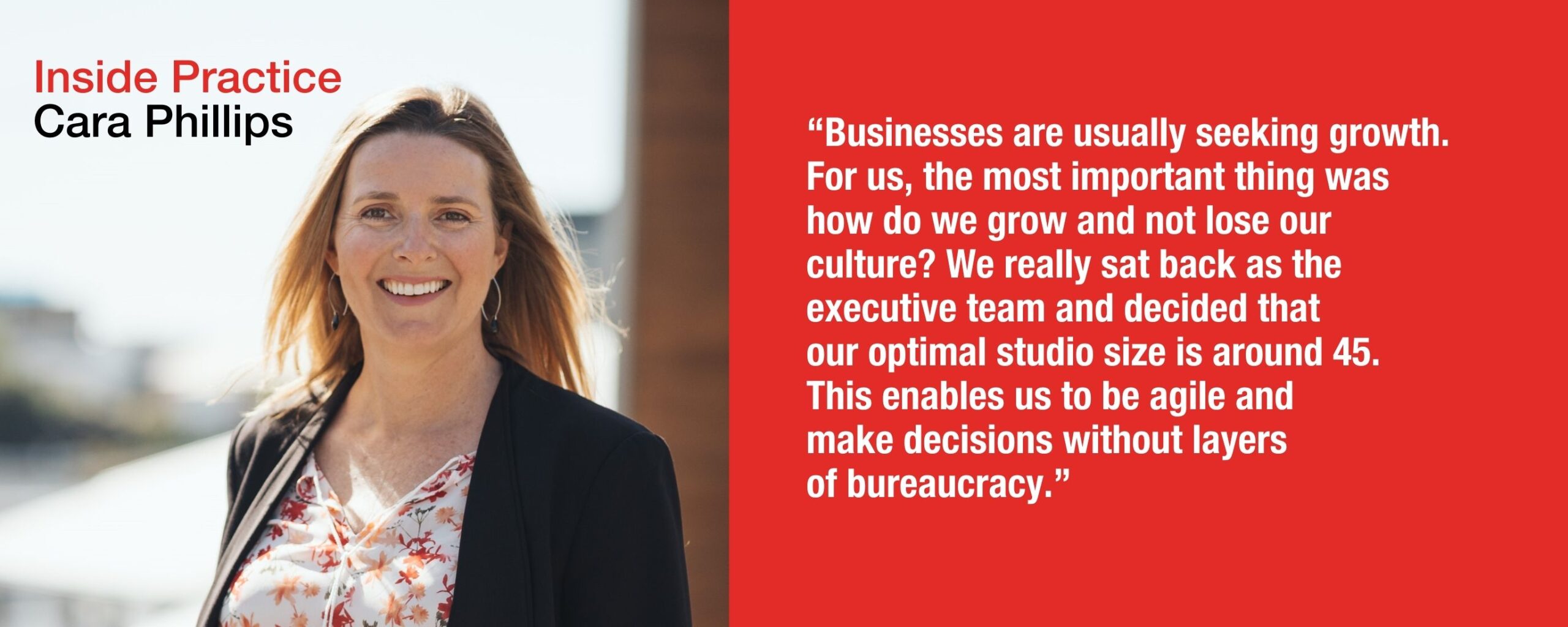
Businesses are usually seeking growth. For us, the most important thing was how do we grow and not lose our culture? We really sat back as the executive team and decided that our optimal studio size is around 45. This enables us to be agile and make decisions without layers of bureaucracy. We made some changes internally to help streamline decision-making and stay agile – this was key to us remaining who we are. From this standpoint, the best way forward was not to grow a particular studio but create a new one – which is what we have just done. In November 2025, BSPN Sydney came to fruition and we are super-excited to watch this flourish.
What leadership approach has served you best in practice, and how has it evolved over time?
I think for me it was hard to let go when moving into a leadership role. It took a lot of effort to step away from the ‘doing’ and into the ‘empowering’. In my early career I used to tell rather than teach. I think it’s still a work in progress for me. I remind myself that there are multiple ways to get to the end result – they might not be my way but they are a right way. It is hard standing back and letting people make mistakes but ultimately it is understanding the difference between coaching and mentoring, and which one to apply.
What’s one thing you wish you’d known earlier in your career?
That everything will be OK. I used to stay up at night a lot and overthink lots of decisions – and architects make a lot of decisions all the time. The trick is to sort through and understand the important and the unimportant and what might land me in jail. Over time, I have become much better at this. I now ask myself two questions when I am grappling / overthinking –
- Is anyone going to die from this decision? I know this sounds drastic but if the answer is yes, then it’s obviously something that is fire/safety related that needs to be addressed and dealt with immediately to reach a conclusion. The second questions I ask is:
- Will this matter in 12 months? Again, if the answer is yes then I deal with this immediately – 95% of the time the answer is ‘probably not’ and is usually just something that I might always see but no one else will ever know. Understanding this need vs want helps to make this process easier.
What challenge has most shaped the way you lead or run a practice today?
Things happen all the time outside our control and I have learnt to go with the flow. I think the last few years have taught us that practices can change overnight, pipelines can disappear and teams dissolve. After COVID we made a very strong strategic decision to diversify as much as possible and to leverage off existing sectors to create new opportunities where we could. I think we are slowly seeing the results of this very considered approach.
Have you ever challenged established norms in architectural business culture to create space for yourself or others? What was the outcome?
I’m not sure – I think being a working mum always has its challenges. We are constantly trying to balance the notion of ‘being a good mum’ vs career progression. I worked three days a week for a lot of years when my girls were young and I don’t think that harmed my career at all. We have a large number of working mums with various flexible arrangements. BSPN actually built and we now run a childcare in Brisbane. This mostly came about because a lot of our great women were finding it hard to obtain quality daycare when returning to work – so we solved this for them. What started as a childcare of about 12 just for staff has now morphed into a fully-fledged Early Learning Centre a block away from the Brisbane office. Our team get priority access and heavily subsided rates, so this has been a win for all the women in our studio.
What advice would you give young women interested in practice leadership or ownership?
Just be you! Life is about nurturing relationships. My standpoint has always been to walk away from any project with relationships intact – so I spend a lot of time nurturing client relationships and those with consultants and builders. I love having networks of people across all sectors that I can call on for advice. The other thing is, put in the hard work. You need to do the time and gain the experience before you gain respect – both for men and women. People can very easily see inexperience on site, so I would encourage all architects to be on site a lot and learn about our craft. This makes you a better designer in the long run.
What change would you most like to see in the industry over the next decade?
I would like to see architecture having the respect it deserves. I feel that as an industry we are misunderstood. The vast majority of people do not really understand what we do, nor understand the value of having an architect involved – with the enormous amount of knowledge and experience we can bring to the table. The most rewarding projects we have are with long-standing clients where we are a part of their strategic planning, helping them realise the site’s potential, masterplanning and then bringing projects to fruition. This is what we are good at.
What motivated you to volunteer on an ACA Committee, and why does contributing to the collective work of the profession matter to you?
I have always liked being involved in the practice side of what we do – the business of architecture. I think what the ACA does for smaller businesses especially – providing so much information and resources – is amazing. I mean, who knew when we were all at architecture school that we were going to have to understand the ins and outs of the employment standards and manage teams and maintain culture – mind blown!
I think the advocacy pieces that the ACA are involved with are crucial to the profession and its survival in the ever-changing construction landscape we find ourselves in today. It’s paramount that we stand together – united as a whole – over the next decade to voice why we are important and relevant. The broader community understanding and valuing the depth of our knowledge is crucial to the viability of the profession. This might sound dire, but we are all aware of this.
The rise of less-qualified people stepping into roles traditionally led by architects cannot replace the years of study, detailed knowledge of construction, and deep understanding of how the built environment shapes people’s lives. Recognising and advocating for this value is critical – and it’s an area where the ACA can play an important role in driving real change.