NSW/ACT President’s comment – July 2026
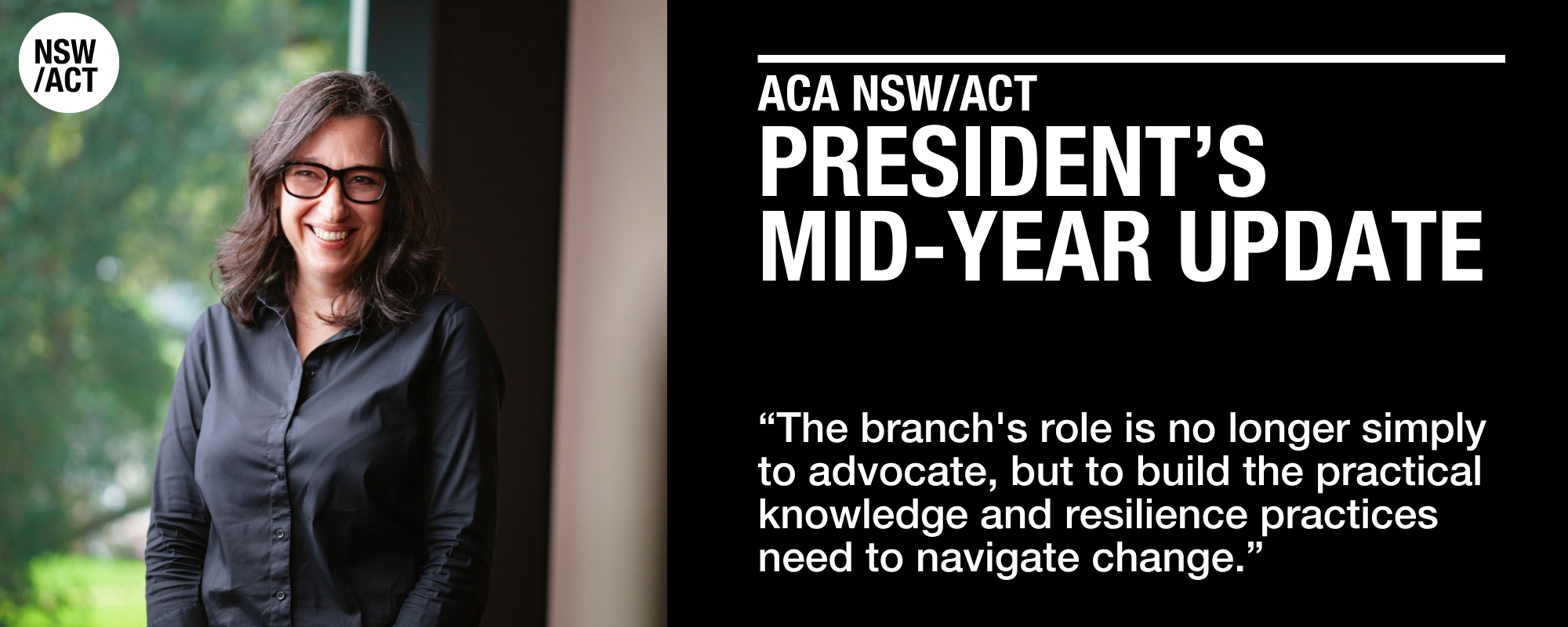
In her latest update, NSW/ACT President Ivana Simkovic provides an overview of branch advocacy, events and the many ways that the ACA is supporting members during this unsettled time.
The first half of 2026 has confirmed what many NSW practices already sensed: the market is growing more complex and less predictable. Some practices report strong workflows, while others are contending with a declining pipeline, intensifying competition and sustained fee pressure, and the gap between stable practices and those under strain is widening.
Against that backdrop, the work of the branch through the first half of the year has been about meeting members where the pressure is greatest: advocating on the issues that shape the conditions of practice, running a program that builds practical knowledge and resilience, and listening closely to what members are telling us about the market.
Advocacy
In June, the amended Building (Approvals and Practitioners) Bill 2026 passed in Parliament without amendments to the Architects Act. Strong advocacy by the ACA, through submissions and appearances at the NSW Legislative Council’s Public Accountability and Works Committee, contributed to the removal of amendments originally in the draft bill. Our branch’s determined push, together with our industry colleagues, has delivered a big win for the community and consumer, and has led to retention of the status quo for the Architects Act in NSW – for now!
Another significant effort this year was a joint statement issued with RAIA NSW on the proposed closure of CSIRO’s North Ryde facility – the site where much of Australia’s fire-resistance and reaction-to-fire testing takes place. Both organisations are urgently seeking to understand the implications of the closure for national fire-testing capability, NCC compliance pathways, modern methods of construction, housing delivery and research capacity.
Together, we support retaining an independent fire-testing capability in Australia and are deeply concerned that the closure of North Ryde without an equivalent, fully accredited replacement presents a serious risk to the community. Our statement calls for a detailed rationale for the closure decision, clarity on the impact to testing and certification pathways, and an update on the status of in-progress test programs. It also raises questions about whether offshore pathways adequately cover BAL products; the delays and costs facing manufacturers; the sector’s diminished capacity to respond to a future cladding-style crisis; the loss of specialist expertise and equipment that would be difficult and costly to rebuild; and the flow-on effects for local manufacturing, construction costs and smaller suppliers.
ACA NSW/ACT also submitted to the NSW Building Commission on its draft Complaints Policy, investigations approach and disciplinary guidelines. The submission calls for the NSW Architects Registration Board to have a clearly defined role in any complaints process involving architects, with explicit notification triggers for both the ARB and the architect concerned, and flags the flow-on implications for professional indemnity insurance. It argues for a single, coordinated process between the Building Commission and the ARB to avoid duplication and deliver consistent outcomes for consumers, and recommends that lessons drawn from investigations be fed back into industry education to strengthen the profession over time.
Events & programs
The events program has focused on the practical realities of running a practice: managing risk, navigating regulation, and protecting the wellbeing of the people who do the work.
In February, the branch hosted a session on decarbonisation in the built environment, presented by Jane Cassidy, Asia-Pacific Service Line Leader for Architecture & Design at GHD and Immediate Past National President of the Australian Institute of Architects. The session covered the Architecture Industry Decarbonisation Plan (2025–2050), practical approaches to carbon measurement, the shift to all-electric buildings, and strategies to meet national climate targets.
In June, the branch presented Managing Risk in Practice, with Madeleine Manousaridis, Building and Construction Senior Associate at Bartier Perry. Madeleine examined how the Security of Payment Act affects day-to-day practice, with practical guidance on managing payment rights and obligations, avoiding common dispute triggers, and resolving disputes efficiently when they arise.
The branch was also well represented at Sydney Build 2026, spending two days at the heart of Australia’s largest construction and design show. On the Construction Wellbeing Stage, ACA member Hamish Ginn – Senior Associate, People and Culture at SJB and a familiar figure in the ACA’s Architects Mental Wellbeing Forum – joined a frank panel on mental wellbeing in construction. On the second day, Sacha Anderson of ARCH joined a panel on designing with Country, exploring how architects can embed Indigenous principles into the built environment to create spaces that are culturally responsive and reflective of the communities they serve.
Pulse Check: NSW Insights
The 2026 ACA Pulse Check drew 69 respondents from New South Wales, 26 per cent of the national cohort, with a profile that mirrors the national picture: small, established firms operating primarily in metropolitan areas. Pipeline remains the central concern, with projects delayed, paused or progressing unpredictably, making resourcing difficult to plan with confidence. Competition has also shifted in character, as practices increasingly contend with larger firms operating at scale, private equity-backed practices and offshore production models, driving fee pressure and, in some cases, aggressive undercutting.
The low-to-mid-rise residential market has contracted, with activity concentrated at the affordable housing and high-end ends of the spectrum. Regulatory obligations continue to expand, particularly under the Design and Building Practitioners Act, while recruitment remains difficult at the experienced end of the profession. Taken together, the results describe a narrowing margin for error in which holding position requires constant adjustment.
Looking ahead
The branch’s focus for the rest of the year follows directly from what members are telling us. Advocacy will remain central, with the CSIRO North Ryde matter a clear priority as the branch presses for clarification ahead of any closure. The events program will continue to build practical knowledge and support resilience, with mental wellbeing, risk and regulation carried through the second half of the year, underpinned by a commitment to reflect the conditions practices are actually navigating.