
Pathway to ownership
What business achievement are you most proud of, and why?
When I first started working as a student at Fulton Trotter, I never imagined that I might one day be an owner of the practice! I am very proud to be an owner of Fulton Trotter and to be able to provide the kind of opportunities that I was given to our talented team.
I am also enormously proud to have built strong long-term relationships with my colleagues, collaborators and clients, to have contributed to the delivery of many education, health and aged care projects that serve our community, to have had lots of fun along the way and to have made a positive impact.
What challenge has most shaped the way you lead or run a practice today?
The COVID pandemic and its impacts on our business was one of the most challenging times in my career. It reinforced the importance of caring for our team, as they truly are the lifeblood of our business. It highlighted the need for consistent and constant communication and how we must work harder at that when so much communication occurs online. And it led us to build in more redundancy and resilience into our practice systems.
Have you ever challenged established norms in architectural business culture to create space for yourself or others? What was the outcome?
After having my first child as a freshly registered architect I requested to return to work part time. At that time there were fewer female architects in the profession and the only part-time staff we had ever had in my practice were the students. I outlined to my directors how I thought I could make my project contributions impactful working three days a week and they supported me to work that way. The result was happy clients and contractors, and a happy me able to spend time with my children. Since that time, many architects in our practice have gone on to work part time and better balance their family commitments while still advancing their architectural careers.
I went on to work part time in the public sector and pressed for and performed leadership roles in that capacity.
Many years later, I returned to Fulton Trotter and became an owner while still working part time. I think I was able to demonstrate that leadership and ownership contributions can look different to the norm and make a positive impact.
What advice would you give young women interested in practice leadership or ownership?
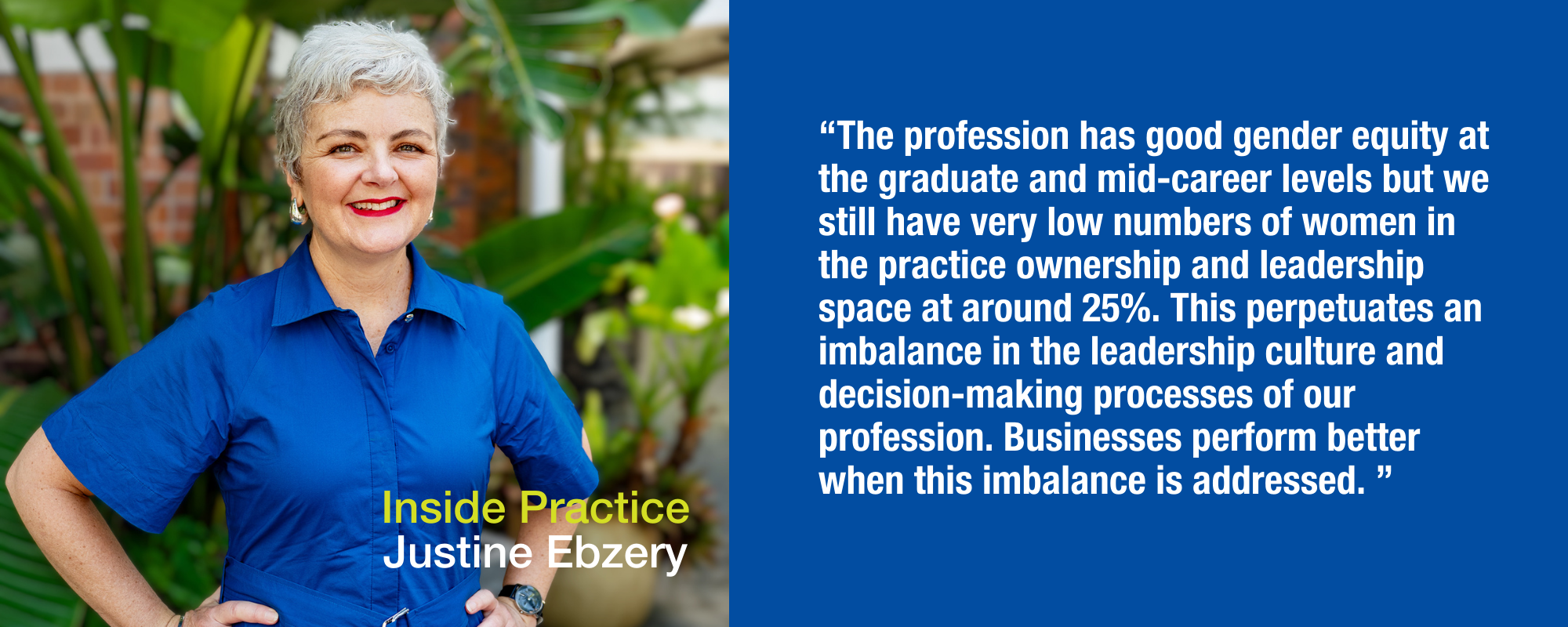
The profession has good gender equity at the graduate and mid-career levels but we still have very low numbers of women in the practice ownership and leadership space at around 25%. This perpetuates an imbalance in the leadership culture and decision-making processes of our profession. Businesses perform better when this imbalance is addressed. I think having more female owners may assist in overcoming some of the structural issues that hinder higher levels of female ownership and will make it more accessible and visible.
I would encourage women architects to consider a future as a practice owner and seek to understand what that involves. If it is of interest, start to build the necessary skills that will support your success as a practice owner. I would also encourage women to invest in building and maintaining their professional network, as this will support any ambitions they have for practice ownership.
What motivated you to volunteer on an ACA Committee, and why does contributing to the collective work of the profession matter to you?
Fulton Trotter have been ACA members for a long time and I had been to many ACA events and regularly used the ACA resources. I attended a combined ACA and AIA event on mental wellbeing in the aftermath of the COVID pandemic, and it really resonated with me. So, when I was asked if I would like to get involved in the Architects Mental Wellbeing Forum I leapt at the opportunity and this led to me joining the QLD/NT committee. I have really enjoyed the collegiate nature of the committee, and it helps me stay up to date on issues that impact our business. The committee members are very generous in sharing their knowledge, they are nice people and we have a lot of fun working together.
I think the ACA does an excellent job of advocating for the profession and has many fantastic resources to support business owners – I am pleased to be able to contribute to that.
Justine is a Director at Fulton Trotter Architects, who have been members of the ACA for many years. She joined the QLD/NT Committee in 2022 and has been the Queensland Chair of the ACA’s Architects Mental Wellbeing Forum since 2020.