Working collectively to make change
What business achievement are you most proud of, and why?
I am most proud of establishing and successfully running a practice for over 20 years in an environment that has not always been easy on female architects or small practices. Sustaining a business over two decades requires resilience, adaptability and belief, particularly when navigating an industry that can be structurally challenging.
A milestone that meant a great deal to us was becoming a Certified B Corp in 2023. That recognition affirmed our commitment to social and environmental performance and to running a responsible, values-driven practice. It formalised something we had always aspired to: aligning business success with positive impact.
Some of the achievements I value most are not the headline moments. They are the small ones: seeing a client smile when a design resolves beautifully, finding an elegant solution to a structural challenge, or bringing a diverse group of stakeholders into alignment. Those moments might seem modest, but they are what sustain a practice day to day. The larger milestones are important, but it is the accumulation of small, meaningful successes that truly defines long-term achievement.
Ultimately, I am proud that we have built a practice that endures, evolves and continues to contribute thoughtfully to the communities we serve.
What leadership approach has served you best in practice, and how has it evolved over time?
It’s important to be yourself. I believe in putting “you” out there and not apologising for who you are – while always ensuring that confidence never tips into arrogance, disrespect or bullying. Leadership, for me, is grounded in being naturally welcoming and inquisitive, and in recognising that none of us know everything.
I learn constantly by listening. I do not pretend to have all the answers. That openness sets an example and helps create an environment where others feel safe to grow professionally and personally. When people feel heard and respected, they contribute more openly and take greater ownership of their work.
My approach to managing business operations has also evolved over time. Early on, there can be a temptation to try to control everything, but that quickly becomes self-limiting. I have learned that sharing responsibility is essential. Balancing oversight with delegation and building the right business infrastructure to support that, is critical to sustainable practice.
Seeking others’ perspectives on business management is one reason I joined the ACA. Being part of a group that shares insights and experience in running practices has been invaluable. We all operate differently, but there is enormous value in learning from one another.
A question I regularly ask myself is: “Why am I doing this?” I try to assess business decisions as rigorously as I assess design decisions. That discipline helps me prioritise, stay focused on value, and avoid unnecessary distraction.
Ultimately, my leadership approach has evolved from doing everything myself to building trust in others, in systems, and in shared purpose.
Where do you see the most positive change happening in architectural practice right now?
The most positive change is happening in the growing willingness across the profession to work more collectively and share knowledge. Architects are increasingly looking beyond individual practices to strengthen the profession as a whole – recognising that collaboration, openness and exchange benefit everyone. This shift towards a more connected culture creates real potential to drive meaningful and lasting change within the Victorian building industry. We need to think global first, then local, then personal, and to see knowledge-sharing not as a risk, but as essential to a stronger, more resilient profession.
What change would you most like to see in the industry over the next decade?
Over the next decade, I would like to see a stronger and more widely understood appreciation of what architects do and the value we bring to people, place and society. That includes deepening our understanding of what First Nations peoples can teach us about this country, and ensuring we properly support graduates and newcomers entering the profession.
We need to think more deeply about how we run practices ethically. The environmental and social benefits we aspire to often conflict with government policies, procurement systems and client instructions. I am guided by a perspective recently shared by my daughter Annabelle in an insightful article prepared for the ACA. She highlights a structural tension many architects experience: the challenge of upholding ethical and cultural standards while operating within commercial systems that can actively undermine them.
When a brief conflicts with core values, the choice can feel stark – walk away and lose income, or proceed and accept compromise. This tension is most acute when government clients are involved, where speaking out may risk future work. This is not an individual weakness; it is a systemic issue.
Collective action is essential. Representative bodies can advocate for:
- Alignment between professional standards and procurement systems
- Shared responsibility, so ethical leadership does not fall on individual practices alone
- Integration of equity, sustainability and cultural responsibility into the way projects are delivered
I would also like to see continued focus on mental wellbeing across the profession. My involvement with the Architects’ Mental Wellbeing Forum reinforced how important it is to support practitioners at every stage, particularly graduates and those from diverse backgrounds.
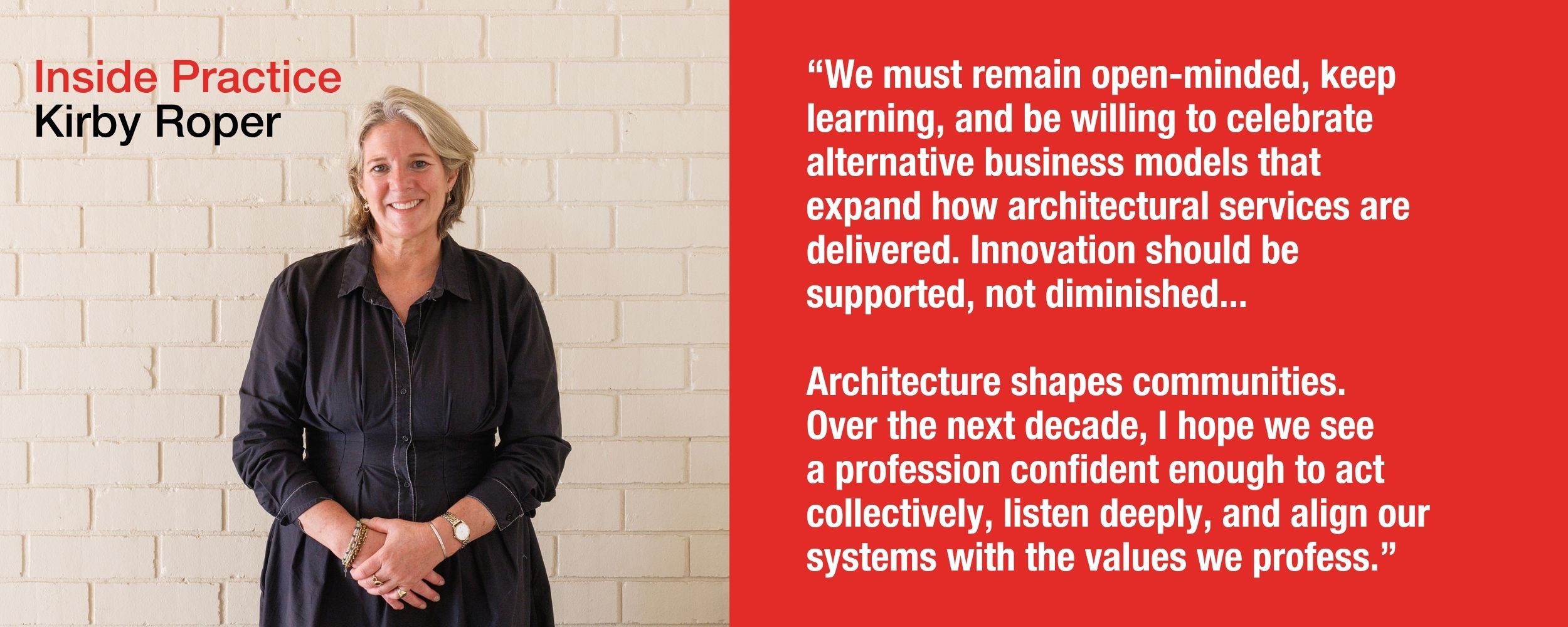
We must remain open-minded, keep learning, and be willing to celebrate alternative business models that expand how architectural services are delivered. Innovation should be supported, not diminished.
Finally, I would like to see Australian Standards once again made broadly accessible. They are fundamental to the built environment and should not be prohibitively expensive to access.
Architecture shapes communities. Over the next decade, I hope we see a profession confident enough to act collectively, listen deeply, and align our systems with the values we profess.
What motivated you to volunteer on an ACA Committee, and why does contributing to the collective work of the profession matter to you?
I joined the ACA in 2016 and immediately wanted to become involved. I joined the VIC/TAS Branch Committee because I believe our profession benefits when we share knowledge, mentor the next generation and actively shape new forms of practice to meet emerging challenges.
Contributing to the collective work of the profession matters. Procurement pressures, ethical tensions and cultural responsibilities are often larger than any one firm. Through representative bodies like the ACA, we can distribute risk, strengthen credibility and advocate more effectively.
As an ACA Committee member, I see our role as helping to shape that collective response. The ACA can:
- Advocate for procurement frameworks aligned with professional standards
- Develop clear policy positions where ethical or cultural principles are compromised
- Provide guidance to members navigating complex decisions
- Coordinate industry responses that allow practices to act with integrity without jeopardising viability
When we work collectively, ethical practice does not depend on individual sacrifice. It is supported by structures strong enough to defend it. That is why contributing to the profession through the ACA is both meaningful and necessary.
Kirby is the Founder and Director of Kirby Architects. She is the ACA VIC/TAS Branch Secretary and has been involved in initiatives like the Architects Mental Wellbeing Forum, advocating for greater diversity and support within our industry.