
Balancing business, design & meaningful impact
What business achievement are you most proud of, and why?
If I was to name a singular project that embodies the knowledge I have acquired over the years, I would name my role in leading the design and delivery of the National Centres for Resilience in conjunction with AECOM during the COVID 19 pandemic.
These were large scale, multi-disciplinary projects delivered across three states within an accelerated program.
We were responding to a national crisis, and our challenge was to create safe, human-centred environments at speed, without compromising dignity, wellbeing or clinical rigour. It required strong leadership, clarity of purpose and close collaboration with government and industry partners.
The complexities were further increased due to us having to concurrently design, document and deliver buildings, while managing large project teams (many of whom we had never met in person) in a remote working environment.
My business-related achievements would include my Executive, Client Strategy and Sector Leadership roles. These roles brought me to my role in leading the Melbourne Studio for GroupGSA. I have undertaken a significant amount of study over the past four years, including the successful completion of the Australian Institute of Company Directors course. Completing this course is generally not in most architects’ wheelhouse due to the high level of business acumen needed. In architectural education we are not taught this type of knowledge. It is learnt while working, if we’re lucky!
Although the achievement was business-related, the real success lay in the application and discipline required to complete the course –particularly while raising a family and working full time.
What leadership approach has served you best in practice, and how has it evolved over time?
Over the past 25 years, a human-centred and strategic leadership approach has served me best.
I have learned that strong outcomes are built on trust, clarity and shared purpose.
Early in my career I focused on design and technical rigour, but as my roles expanded into Executive and Principal roles, my focus has broadened to include business performance, mentoring and sector leadership.
Today, I lead by setting a clear vision, supporting others to grow, and ensuring our teams understand both the human impact and the commercial context of their work. This balance has been key to sustaining high-performing teams and long-term client relationships.
What challenge has most shaped the way you lead or run a practice today?
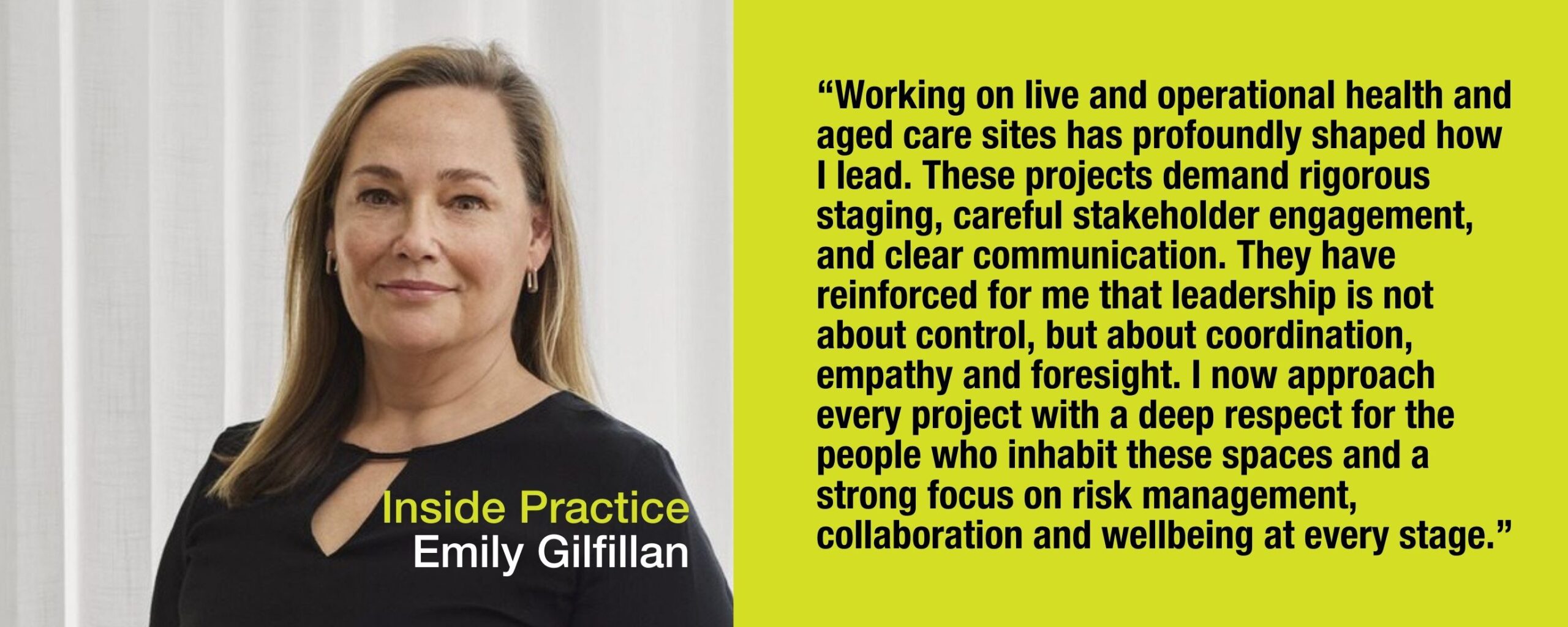
Working on live and operational health and aged care sites has profoundly shaped how I lead. In these environments, construction cannot disrupt care, and the stakes are high for residents, staff, and families.
These projects demand rigorous staging, careful stakeholder engagement, and clear communication. They have reinforced for me that leadership is not about control, but about coordination, empathy and foresight.
I now approach every project with a deep respect for the people who inhabit these spaces and a strong focus on risk management, collaboration and wellbeing at every stage.
What change would you most like to see in the industry over the next decade?
I would like to see greater diversity in practice leadership and a stronger recognition of architecture as both a creative and strategic profession.
Architecture influences health, education, housing, and community wellbeing. Yet we often undervalue our role in shaping policy, business strategy, and long-term social outcomes.
I hope to see more women and diverse voices in ownership and executive roles, and a profession that confidently articulates its value beyond aesthetics, positioning architects as essential contributors to societal resilience and sustainability.
What motivated you to volunteer on an ACA Committee, and why does contributing to the collective work of the profession matter to you?
Volunteering with the ACA is a natural extension of my commitment to the profession. Throughout my career I have engaged with industry bodies, advisory groups and judging panels, and I see this as part of our responsibility as senior practitioners.
Architecture does not operate in isolation. The health of our practices, the standards we uphold and the opportunities available to emerging architects are shaped by collective effort.
Contributing to an ACA Committee allows me to share practical experience from executive leadership, client strategy, and project delivery, while also learning from peers. It strengthens the profession as a whole and ensures we continue to evolve in a way that is ethical, inclusive, and commercially sustainable.
Emily Gilfillan is a Principal and Melbourne studio lead of GroupGSA. She has been a member of the ACA VIC/TAS Committee since 2024.