Listening on Country: Jo Best
Does your practice have a RAP, and if so, what impact has it had on your practice?
Yes. It has been a good document to develop, consolidating our approach and lessons learnt through almost five decades of working with Aboriginal clients. For Troppo, the RAP is reflective of our experience, rather than generic statements that lack meaning, regardless of good intentions. Everyone within the practice needs to learn from positive experiences and previous wrong turns. Our RAP remains a fluid working document that is continually updated and finessed.
Beyond project work, how do you build First Nations cultural awareness and learning into the everyday life of your practice?
Being in the NT, engagement with Aboriginal people is constant. Living side by side, getting to know your neighbours, your community, your representatives, and being a part of the rich cultural fabric is fundamental to being a citizen across all of Australia.
Listening to Aboriginal people in our community, working together to improve our society to reflect a common happiness for all people seems a simple way to bring us together. Through this dialogue, we can begin to better understand other people’s perspectives, both ways.
What advice would you give to practices looking to embed First Nations cultural stories or perspectives in their work in a genuine and meaningful way?
A co-design process – developing the design with a recognised Traditional Owner or a delegate of the people who have authority to share stories – is essential to any meaningful representation.
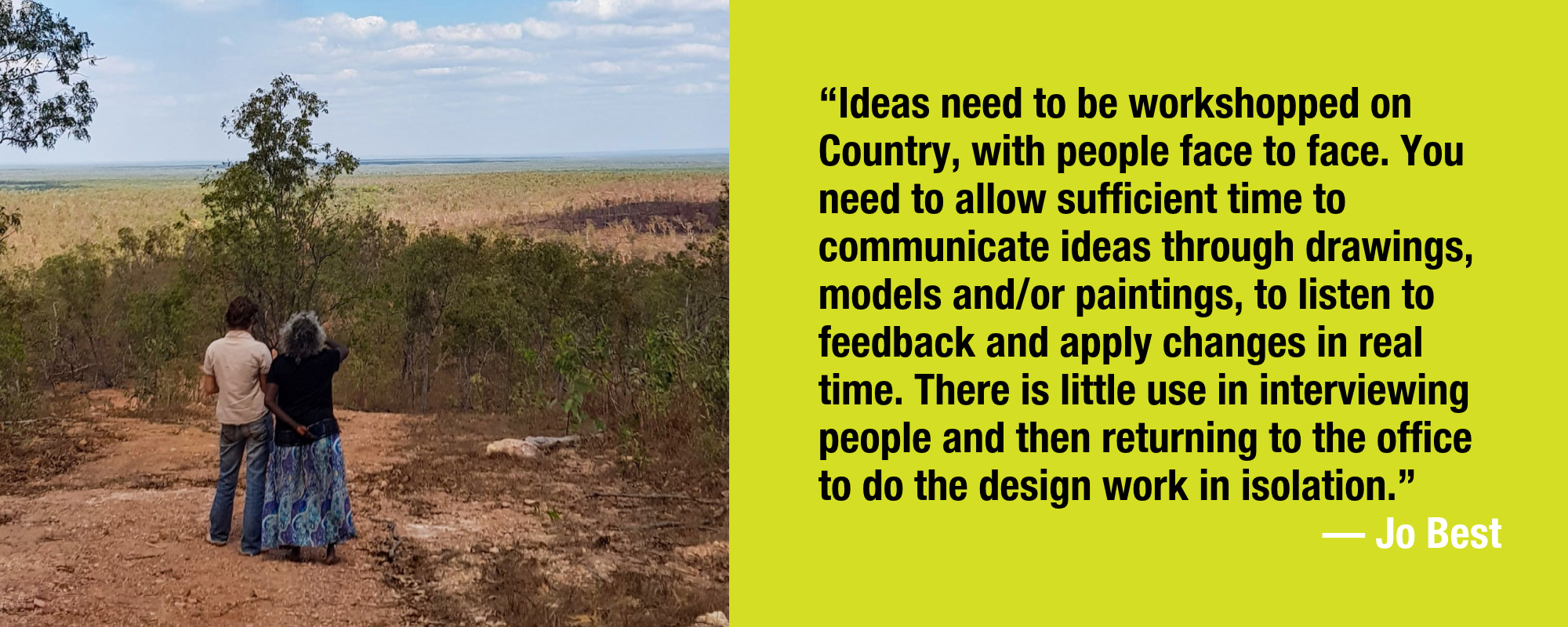
Ideas need to be workshopped on Country, with people face to face. You need to allow sufficient time to communicate ideas through drawings, models and/or paintings, to listen to feedback and apply changes in real time. There is little use in interviewing people and then returning to the office to do the design work in isolation.
Include artwork and cultural meaning as a layer embedded into the architecture and, most obviously, don’t appropriate. Any cultural representation needs to be carefully developed with people who have authority to talk, design or make for that place and clan group. Sometimes, a delegate group needs to select the person/s who have licence to represent the local mob.
You need to pay people for their time in developing an idea, and then for use of that artwork, story, song or design.
There are a few different ways that people can be paid for the artwork:
- The original piece is bought and can only be used in its original form.
- A licence is paid to use a facsimile of the work, and the artist retains the original. If this is the option, then there needs to be full understanding of any alteration of the work in scale, material or form. Ideally, the artist is involved in the development of the new work.
- The two above, together.
When engaging with First Nations communities, how do you find the right organisation or person to speak to, and how do you know they have the cultural authority to represent the community on the issues you’re working through?
If you are new to a community or organisation, it can be difficult to immediately identify who has the authority to speak to a particular place, protocol or approach. Representatives at your local Aboriginal Land Council can help identify the right people, but you can’t assume it will be appropriate for you to meet with them, so an intermediary may be needed.
When you’re in a place where English may be the third, fourth or fifth language, a translator (at least at the outset) can help build relationships with less ambiguity, developing clear understanding around your reason for being there.
Making multiple site visits is essential for building relationships, developing ideas, and deepening your understanding of place. Where different groups within the community prefer to meet separately (for example, where gender separation protocols apply), accommodating these preferences is key to understanding the full dynamics of your client group and ensuring all voices are heard.
What role do you believe the architecture profession has to play in advancing reconciliation, justice and truth-telling in Australia? Is the profession currently living up to that responsibility?
We can contribute so much, not only through our practice of architecture, but also from a legislative perspective.
Ensuring you have First Nations people on your design team to work as your cultural conscience should be compulsory, especially for public projects.
We can also push governments to recognise a First Nations understanding of place through planning processes, schemes and mapping. Understanding and respecting the creation stories in your own backyard can enrich practice beyond the prosaic whitefella prism.
Can you describe a project where Country fundamentally shaped the outcome?
The Djómi Museum continues to be a project that connects us to the people and place of Maningrida. The co-design references the creation story of the Djómi and Bábbarra and is manifest in a multi-sensory experience that houses precious objects from Maningrida and the surrounding Homelands. It also provides a new working Culture Hub to receive, catalogue, protect and store objects that are finally coming home, preserving the cultural heritage of the region.
How do you navigate tensions between client expectations and Country-led design principles?
We will always advocate for our First Nations brothers and sisters, and any tensions usually lie with a lack of understanding or education from a whitefella client perspective. As such, nearly all the work we do is directly with the people who will use the building. Often, we work pro bono at the beginning to assist with funding submissions that allow Traditional Owners to retain control of their project on their Country.
In the NT, there is a shocking amount of taxpayer money wasted through NTG administration and management of projects on Country that would be better spent on the actual build.
What are the most challenging aspects of working in this space for your practice? Where do you see architects most commonly getting it wrong?
Challenging is not a word I would use to describe what is a professionally fulfilling experience. There can be long hours, lots of dusty travel, not much sleep, but the payoff is well in our favour. To get to spend time on Country with custodians is the best education an architect can ever have.
Getting it wrong? Not listening, but also not being brave enough. For some reason, there has been a kind of mysticism built up around working with First Nations people. Yes, you need to have an appropriate agenda and systems around cultural protocol and correct procedure, but no-one expects you to know everything. And despite centuries of oppression, the staggering truth is that First Nations people are extremely generous in helping grow understanding across the wider population about their culture – to help us get it right. You must go in with an open heart.
Jo Best is a Director at Troppo Architects, based in Darwin.