
Listening on Country: Andrew Broffman
What advice would you give to practices looking to embed First Nations cultural stories or perspectives in their work in a genuine and meaningful way?
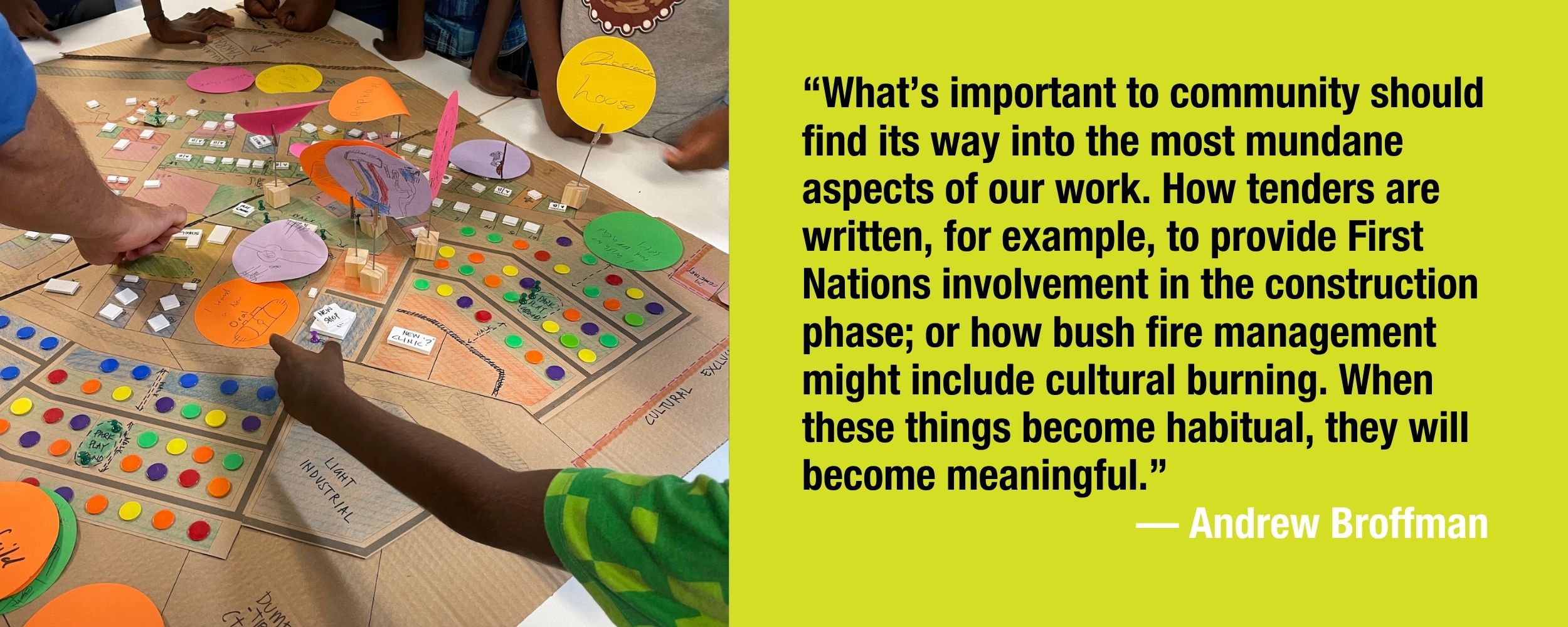
To meaningfully embed First Nations perspectives, they need to become part of our working habits. It’s encouraging to see this happening with educational and professional competencies. In everyday practice, this starts with valuing (and paying for) cultural knowledge and input by First Nations consultants or through paid opportunities for community members. It means expanding site analysis beyond a constraints approach to embracing a deeper appreciation of Country and its opportunities. What’s important to community should find its way into the most mundane aspects of our work. How tenders are written, for example, to provide First Nations involvement in the construction phase; or how bush fire management might include cultural burning. When these things become habitual, they will become meaningful.
When engaging with First Nations communities, how do you find the right organisation or person to speak to, and how do you know they have the cultural authority to represent the community on the issues you’re working through?
We never assume or try to determine who speaks for Country. Where Native Title claims have been successful, Traditional Owners (TOs) will be key stakeholders. In some jurisdictions, Land Rights Acts establish Land Councils that have been vested with cultural authority. But legislative requirements alone may not resonate with all community members, some of whom consider themselves to be rightful Custodians. To navigate the complexity, we cast a wide net to try and ensure the range of community members, families, TOs, custodians and cultural organisations all have an opportunity to participate in project decision-making. The key is to accept the uncertainty, avoid the temptation to simplify it, and work with communities in all their complexities to shape design responses.
How do you navigate tensions between client expectations and Country-led design principles?
The key is to change the financial relationship. Many projects in First Nations communities are funded by State and Commonwealth governments who have their own agendas and timelines. These are often at odds with what communities want. Instead, we look for opportunities to work directly with communities who determine their own priorities: when meetings should take place, who needs to attend, what’s important about Country and community. It’s not easy, of course, but we’ve had successes in encouraging governments to relinquish some control of the money story and allow communities to manage their own project funds. Country-led design principles are more likely to flourish where decision-making resides, not with anxious bureaucrats, but with community.
What are the most challenging aspects of working in this space for your practice? Where do you see architects most commonly getting it wrong?
Clear and regular communication with First Nations stakeholders is the key to getting it right. Building projects and processes can be complex and difficult to convey. This is especially the case when working across cultures and languages. Having a local liaison can help to build trust between consulting teams and communities. Allowing time in delivery programs for more impromptu gatherings at the local sports hall or shop will help capture inputs that may not present themselves in the formal conference room. Posters, flyers and social media can all help to ensure communication is broad enough to encourage wider interest in community projects.
What role do you believe the architecture profession has to play in advancing reconciliation, justice and truth-telling in Australia? Is the profession currently living up to that responsibility?
The architecture profession – like all industries – has a responsibility to support the broader, ongoing project of social justice in Australia. Within the built environment, at its various scales, this includes designing safe, welcoming and affordable public spaces. In housing, it means advocating for more social and affordable housing. Importantly, it also means the courage to refuse commissions that reinforce inequalities and work against social justice. Too often we see, for example, well-regarded architects working on projects that reinforce urban gentrification by replacing social housing and diverse neighbourhoods with higher-end developments. The question architects need to ask themselves is: how is my work making the world a more just place? The younger generation of architects is eager to see change in how we work as designers and what our role in public life should be. This should give us hope.
Andrew is a Principal and Registered Architect at The Fulcrum Agency, a practice of architects, project managers and grant writers who support First Nations-led projects across Australia.
He spent 14 years as Managing Director of Alice Springs-based Tangentyere Design Architects, one of Australia’s most respected Aboriginal-owned, not-for-profit architectural firms. Years of working across the NT have given him a profound respect for its peoples, cultures, and the unique sensitivities that come with operating in such a deeply significant place.
Andrew always works for the benefit of community, sustaining culture first and foremost.