Listening on Country: Sue Dugdale
Beyond project work, how do you build First Nations cultural awareness and learning into the everyday life of your practice?
We are lucky to live and work in Alice Springs, which has a strong Arrernte presence as well as many First Nations people from remote communities who use the town as a service centre. We hear many First Nations languages spoken in the mall outside our office every day. Until I lived here, I wasn’t aware of how vibrant and alive First Nations language and culture is in Australia today.
Our town offers many opportunities for engagement in First Nations cultural activities, from political rallies to art and music events such as the annual Parrtjima light show, to footy games and sports weekends in remote communities.
What advice would you give to practices looking to embed First Nations cultural stories or perspectives in their work in a genuine and meaningful way?
Be open to and accepting of the level of engagement and input from local First Nations representatives and community members. They are most likely busy people with many demands on their time, often expected to represent their culture and community and give their time without compensation. I recommend assuming that financial remuneration is appropriate for all types of expert advice – whether it be from an engineer, historian, or First Nations cultural advisor.
The potential to represent First Nations cultural stories or perspectives will vary between various projects. Depending on this, your response could be relatively small – perhaps a gesture such as a graphic of a single flora or fauna with known cultural meaning. Alternatively, it could be as big as a design partnership where First Nations representatives work with the architectural team to design positively with sacred sites or develop a functional brief from first principles. Early consultation with First Nations representatives before design starts will show the potential within a particular project.
When engaging with First Nations communities, how do you find the right organisation or person to speak to, and how do you know they have the cultural authority to represent the community on the issues you’re working through?
We rely completely on First Nations people and organisations to provide this advice. Sometimes the advice about who to talk to isn’t as immediate as non-First Nations people would expect. Determining who has cultural authority in a certain context (especially when the matter is cross-cultural) may take careful consideration and discussion by an organisation or community. It helps to be open and curious, and to always ask a person you have consulted whether there is someone else they would like you to talk with.
What role do you believe the architecture profession has to play in advancing reconciliation, justice and truth-telling in Australia? Is the profession currently living up to that responsibility?
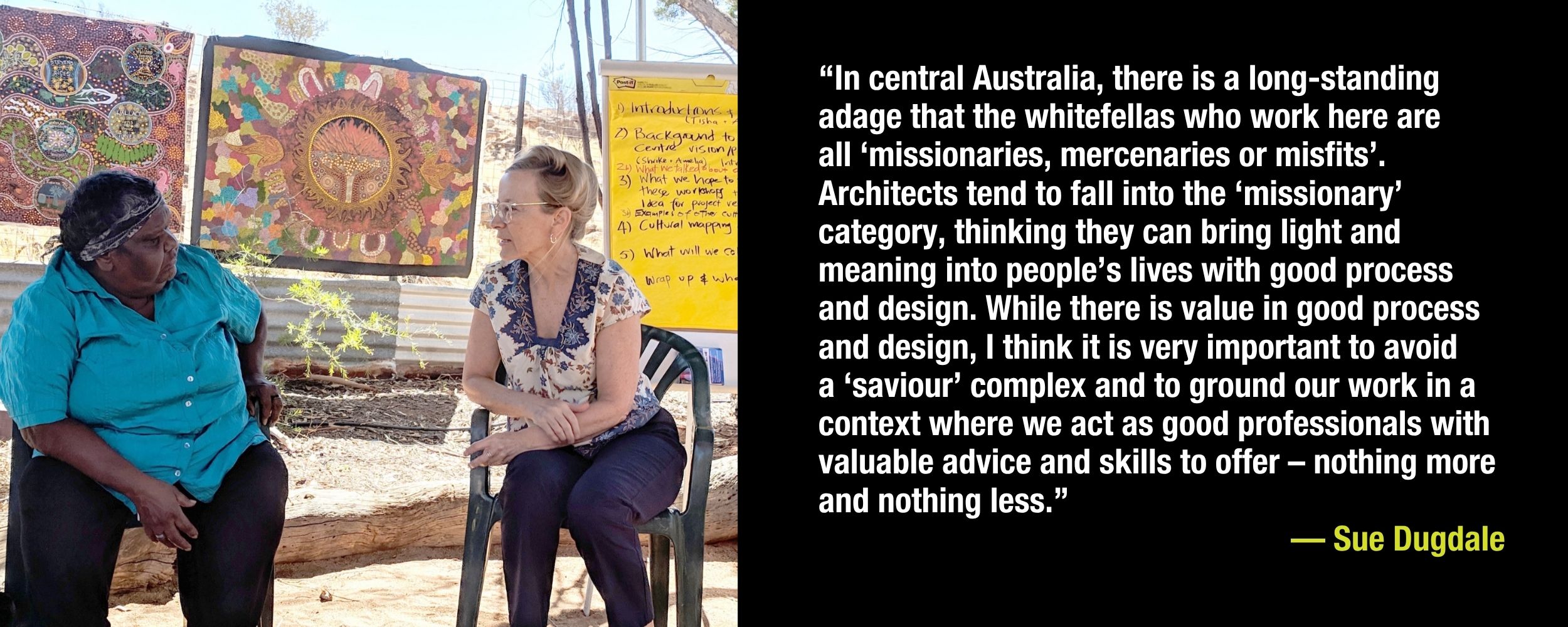
In central Australia, there is a long-standing adage that the whitefellas who work here are all ‘missionaries, mercenaries or misfits’. Architects tend to fall into the ‘missionary’ category, thinking they can bring light and meaning into people’s lives with good process and design. While there is value in good process and design, I think it is very important to avoid a ‘saviour’ complex and to ground our work in a context where we act as good professionals with valuable advice and skills to offer – nothing more and nothing less.
The best role the architecture profession can offer at an individual level is respectful relationships with First Nations communities and being willing and open to incorporating their advice into projects. It is also important for bodies such as the ACA and AIA to support national-level issues of importance to First Nations communities such as the referendum on The Voice.
At the moment, the profession seems to be living up to the responsibility to advance reconciliation, justice and truth-telling through the design competencies, which engage all young architects. And there are many really good practitioners in Australia – The Fulcrum Agency, Officer Woods, Tangentyere Design, POD, Rossi Architects and Kaunitz Yueng to name a few. There are many more.
What have First Nations collaborators taught your practice that you didn’t expect?
Working on the Akeyulerre Healing Centre (completed in 2024) gave us insights into Arrernte culture. Although the place is called a Healing Centre, this is synonymous with a Cultural Centre – healing practices are cultural, and culture is and provides healing.
We have become more aware of the huge weight of responsibility that rests with Traditional Owners and Custodians. It is not as if they are Board members (although they also often are) who can switch off from the task. They bear a deep, lifelong personal responsibility to their community and to the land that is sometimes described as their mother. Their actions in representing culture and protecting land will leave an enduring legacy for better or for worse and may also viscerally affect them, in that their own physical health can be affected by how they exercise their responsibilities.
Sue Dugdale is the Director of Susan Dugdale and Associates, based in Alice Springs.