
Leadership by Design
What leadership approach has served you best in practice, and how has it evolved over time?
The leadership approach that has served me best is “power with” rather than “power over”. Early in my career, I assumed that if everyone had good intentions, things would naturally run smoothly. Over time I realised that relationships unravel when expectations are mismatched or when someone feels undervalued.
At Maytree we use the SCARF model as a practical lens for understanding motivation. People are looking for Status, Certainty, Autonomy, Relationship and Fairness. When I take the time to understand what drives a team member, client or consultant, tricky conversations become easier and outcomes improve. It also helps me reflect on my own drivers.
For me, the biggest hurdle to good leadership is ego. The more self-aware I become about my strengths and weaknesses, the less reactive I am. Staying open and curious, rather than defensive, has been the biggest shift in my leadership over time.
Have you ever challenged established norms in architectural business culture to create space for yourself or others? What was the outcome?
In our journal article Building a Practice of Kindness, I wrote about a quiet but deliberate shift away from the idea that good architecture requires burnout, hierarchy or self-sacrifice. For us, challenging the norm meant designing the practice as carefully as we design our projects.
We introduced a nine-day fortnight and a strict no-overtime culture. We became clearer about fees, scope and boundaries so that delivering a client’s dream doesn’t come at the team’s expense. We prioritised early conversations about capacity and timeframes, rather than rewarding last-minute heroics.
Kindness, in this context, isn’t softness – it’s structure. It’s clarity around expectations, shared responsibility and respect for people’s lives outside work.
The outcome has been a more sustainable studio. Staff retention is strong, projects are better managed and clients benefit from a team that is focused, steady and genuinely engaged – not exhausted.
What advice would you give young women interested in practice leadership or ownership?
Don’t underestimate your soft skills. The ability to read a room, navigate relationships and the humility to take responsibility when required is powerful in leadership. Many women already have these skills in buckets – if you want to lead, hone them.
Be curious about how people think and how workplaces function. There is no shame in building knowledge around business, finance, communication and emotional intelligence.
What change would you most like to see in the industry over the next decade?
I would like to see a profession that clearly demonstrates its value to the community.
Our built environment is under increasing pressure. We need an active, problem-solving and engaged profession. Part of the challenge is that many practices lack strong business and communication foundations. Talented designers can struggle because they don’t manage finances well, forecast effectively or build healthy teams.
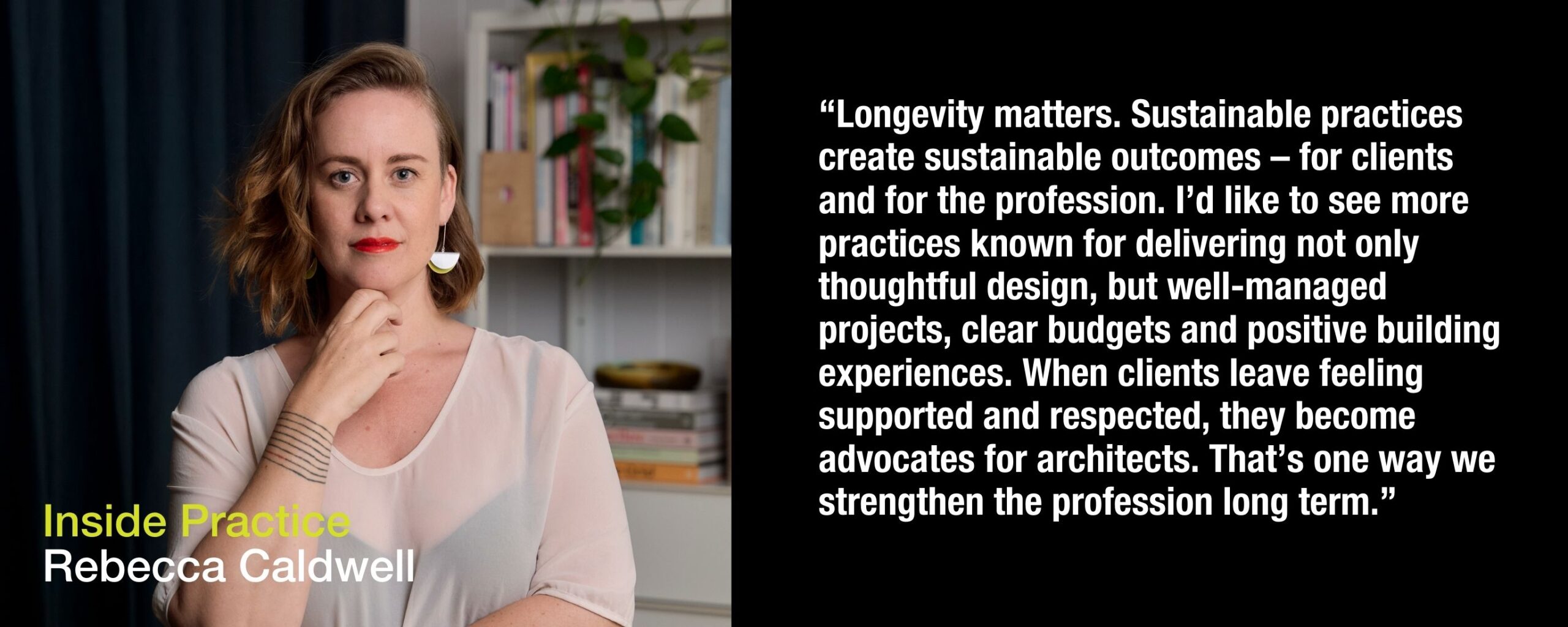
Longevity matters. Sustainable practices create sustainable outcomes – for clients and for the profession. I’d like to see more practices known for delivering not only thoughtful design, but well-managed projects, clear budgets and positive building experiences. When clients leave feeling supported and respected, they become advocates for architects.
That’s one way we strengthen the profession long term.
What motivated you to volunteer on an ACA Committee, and why does contributing to the collective work of the profession matter to you?
When my children reached school age and the business felt stable, I finally had the space to give back. In small residential practice it’s easy to operate in a bubble, and I wanted to connect more broadly across the profession.
I’d seen BoSP events running in other states and was already having regular conversations with small practice owners facing similar challenges to me. It made sense to bring that forum to Queensland. I’ve loved getting it established and, more recently, shifting to smaller gatherings hosted in other studios’ offices. The intimacy has led to more honest, practical conversations.
A side benefit of joining the committee has been meeting generous, experienced practitioners with far more runs on the board than me. Stepping outside my comfort zone – including learning how to navigate committee meetings! – has been personally rewarding. It’s given me new skills, broadened my perspective and strengthened my sense of belonging within the profession.
Rebecca Caldwell is a Director of Brisbane-based Maytree Studios, an employee-owned studio that combines ethics and social responsibility with the forward-thinking sensibilities of contemporary architecture. The driving idea behind the practice is that good architecture should be grounded in kindness. Rebecca is passionate to show that profitable business, good design and staff wellbeing are all achievable in small practice. As well as employee ownership, Maytree has a nine-day fortnight, policies on parental leave and overtime, and has engaged with the ACA’s Employee Assistance Program (EAP).