
Arch_Manu research project – July 2026 update
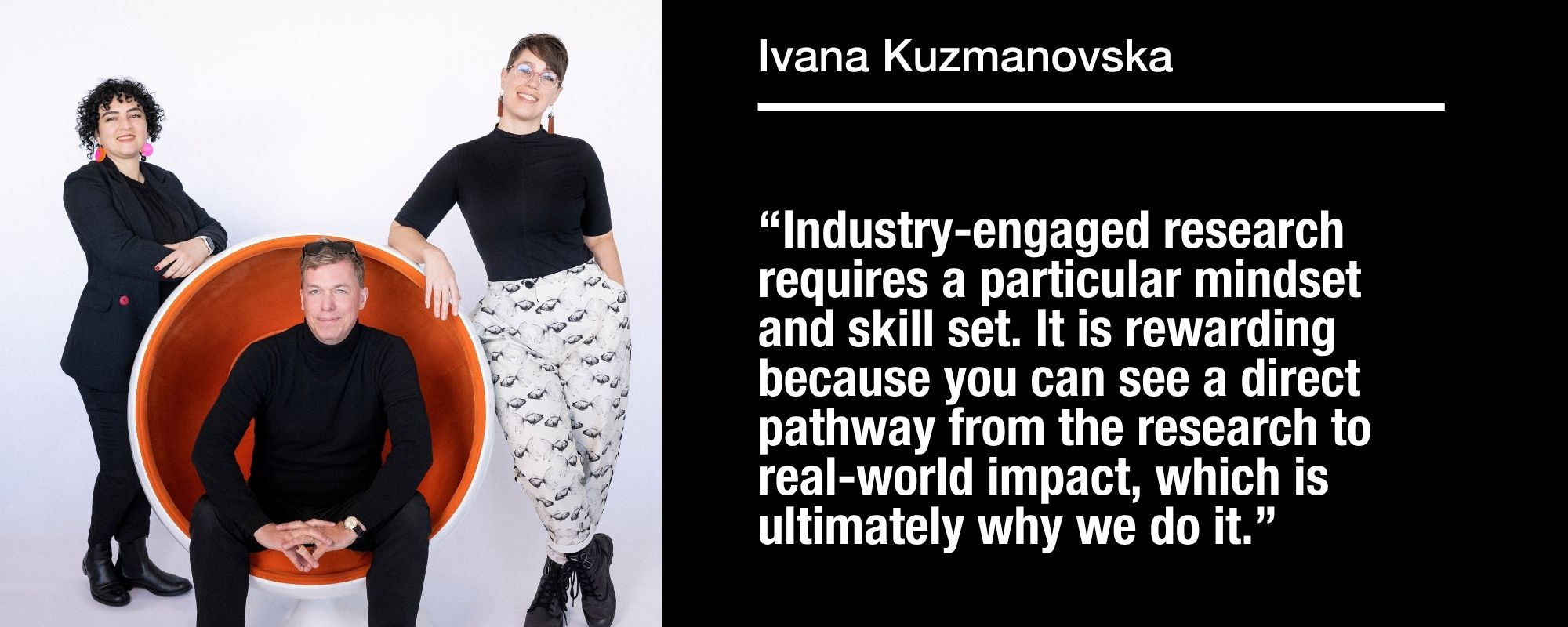
It has been almost three years since we interviewed M. Hank Haeusler about the Arch_Manu research project, of which the ACA is a proud partner. Ivana Kuzmanovska provides an update, sharing generous insights on the project’s progress to date, her research highlights, and ambitious plans for the future.
What is your role with the organisation? What experiences have shaped your approach to leading a project of this scale?
As the Manager of this ARC-funded Industrial Transformation Training Centre (ITTC), my job is to make sure we deliver on all the ambitious promises made in the grant application that secured us five years of funding. Day to day, I work closely with the Centre Director, Professor M. Hank Haeusler, and our Continuing Professional Development Lead, Dr Farnaz Fattahi. We are an itty-bitty but formidable operational dream team. My role touches almost every part of the Centre: strategy, governance, finance, reporting, recruitment, events, marketing and communications, research training and partner engagement. That variety is part of what makes the job so interesting. There are always new problems to solve and constant on-the-job learning.
The Centre currently includes around 85 people across 16 organisations, including 21 direct-funded PhD/MPhil Candidates and 3 Postdoctoral fellows, as well as a growing network of affiliated PhDs and scholars. A big part of my job is connecting people across these different institutions, disciplines, and industry organisations. I want the Arch_Manu team to feel like they are part of one shared program and vision, rather than working away on a series of separate projects. That shared vision is framed by our high-level aims of leveraging digital technologies to reduce carbon emissions, resource consumption, and waste production within the AEC sector, while helping to deliver projects on time, on budget, for the benefit of the community. We have posters proudly displayed in each of our offices across Sydney, Melbourne and Adelaide reminding us of these aims.
Before joining Arch_Manu, my entire academic career had involved industry-engaged research, so this role felt like a natural fit. I started my PhD in an ITTC similar to Arch_Manu, so I have an understanding of what the experience is like from the PhD candidate’s side. I then moved into a CRC-P project, where I worked closely with industry partners in construction and development. During my postdoc with the Future Building Initiative at Monash University, I led cross-disciplinary research teams across a number of Building 4.0 CRC projects looking at product and process innovation in prefabrication, mass timber construction, and modern methods of construction more broadly. We worked with developers, construction companies, prefab businesses, manufacturers and researchers from a wide range of disciplines.
That experience was incredibly useful when it came to establishing Arch_Manu. Industry-engaged research requires a particular mindset and skill set. It is rewarding because you can see a direct pathway from the research to real-world impact, which is ultimately why we do it. But it also requires a lot of flexibility. Industry timelines do not always line up neatly with research timelines, and they certainly do not wait for them. You can’t anticipate every challenge, and so much of the work is about listening, adapting, solving problems as they arise, and sometimes finding fairly unconventional ways forward. In setting up Arch_Manu, we have tried to create the infrastructure that allows this kind of flexible and opportunistic interaction between researchers and industry partners. We are testing new ways of working together, reflecting on their success, and adjusting as we go.
I should also mention that, in our quest for world domination (muahaha), Hank and I have been building Arch_Manu as a broader umbrella organisation, extending the work of the ITTC through several aligned initiatives. Among these, there is BÜRO, where we test research ideas through built projects, including experiments with heat-pressed mycelium sheets, 3D-printed acoustic panels, bioshelters in Sydney Harbour, and public art installations featuring construction waste streams. There is CODE, where we develop computational workflows and products, including Lamina, our new design software for 3D printing, recently launched by Dr Zayad Motlib. And there is CPD-P, our platform for lifelong learning and a key pathway for getting research out of the university and into practice.
The Arch_Manu project is nearing its halfway point, an appropriate time to stop and reflect. Looking back, what have been the most significant insights or lessons you’ve gained so far?
One of the biggest insights has been a much more nuanced understanding of why meaningful change can be so difficult. Personally, that has played out in two different ways.
The first is a bit of a lesson about how large organisations work. Managing this ITTC has given me a peek behind the curtain at the machinery of university systems, and I suspect they are probably not that different from governments or other big organisations. When you are trying to do something innovative or unusual, the one-size-fits-all policies and procedures that large organisations rely on can become a real challenge. There are often several departments responsible for different parts of the same process, and it can be difficult to find a way forward when what you are doing does not fit neatly into an existing box.
It has made me realise how deeply embedded ‘business as usual’ can be, and why it is so hard to shift. We see the same thing across industry. Even when people agree that change is needed, the systems around them are not always set up to support it.
The second lesson has been around access to projects and data. We have been very lucky with our partners. They have generally embraced open collaboration, which has allowed us to have honest and productive conversations about the pain points facing the industry. They understand that being open about their ‘dirty laundry’, so to speak, is useful because chances are that other organisations are dealing with many of the same problems. But turning that openness into access to live projects and data is more complicated. Our direct partners might be completely supportive, but the projects they work on are often owned or controlled by clients, consultants or other stakeholders who are not directly involved in the Centre. Without approval from that broader group, access can still be difficult (even if the client in question is the University you work for, who is completely supportive of the research!)
We are finding ways to work around this, but it has shown just how many people and relationships are involved in making even small changes. Goodwill is important, but it is not always enough. You often need alignment across a much wider ecosystem. That is particularly relevant to the big issues we are interested in, such as the transition towards sustainability through digitalisation. These are not purely technical problems. You can develop the best tool in the world, but if people do not trust it, understand it, have permission to use it, or see how it fits into their existing work, it will not go very far. The technical, social and cultural parts of change have to be addressed together.
Which research activities have had the greatest impact to date, and why do they stand out?
The first initiative that comes to mind is our hackathon program. Since Centre commencement in 2024, we have run six hackathon events, involving participants from across Australia, Europe and the USA. These events give people from different organisations and disciplines a chance to step away from their normal day-to-day work, focus on a problem together and test ideas quickly. We invite project proposals from the entire team. Initially they were coming more from the industry side, but increasingly our PhDs and Postdocs have been throwing ideas in the ring as their research questions have firmed up. The outcomes are not always a finished tool or product, but that is not really the point. Often the biggest value has been in helping people define a specific problem more clearly, uncover practical barriers, and build relationships. That trust then creates opportunities for further collaboration, which we have seen play out in the PhD research.
So far, our hackathons have been internal, involving Arch_Manu researchers and partners. However, we have had a lot of interest from people outside the Centre, so we are now looking at ways to open them up more broadly. Stay tuned!
Another initiative that really stands out is our Continuing Professional Development (CPD) framework. This framework has been developed as a direct way of connecting practice with the latest research. Rather than waiting until the end of a project to share findings through traditional academic channels (which often don’t end up reaching industry audiences anyway), our CPD offerings allow emerging research to be translated into professional learning and shared directly with practitioners. It creates a much more immediate pathway between research and practice, while also giving researchers valuable feedback on how their work is understood and applied by industry.
The focus of our CPD content to date has largely been on addressing the digital literacy gap emerging in practice as AI and other digital technologies alter the professional landscape, and we have been incredibly lucky to be supported in this initiative through collaborations with the ACA as well as other peak bodies including the Australian Institute of Architects, the Regional Architecture Association, and Architectural Designers New Zealand. In July this year, we married our CPD efforts with the delivery of the 2026 International Conference on Computational Design and Robotic Fabrication, offering the conference keynote lectures by esteemed international researchers as formal CPD activities for local architects. As part of the conference program, we also offered several skills-based Masterclasses to share the findings of an ongoing research project on circularity being conducted by Arch_Manu researchers in collaboration with academics from USYD, QUT, and RMIT.
Registration numbers alone can’t measure impact, but they can give an indication of reach; in 2025, we delivered 51 formal CPD events with more than 900 practitioners engaging with our CPD content. In the last financial year, we had more than 1,600 registrations across our different CPD offerings, indicating that our reach is steadily growing and that there is an appetite in the market. Most of our content is free and available through our website, which is becoming a useful resource for architects and engineers looking to build their knowledge of digital tools, techniques and workflows.
Our industry-embedded research is also having an important impact, although much of that will take longer to become visible as the PhD and Postdoctoral projects that have been established in the last two years mature. Hopefully, we can do another interview like this at the five-year mark, and I can tell you more about the outcomes of our PhD and Postdoctoral research.
By embedding researchers in partner offices, we are helping make sure the work stays connected to practice, but at the same time, the researchers are learning how to work in an industry environment, which is valuable in its own right. The profession is changing very quickly, and I think there will be increasing demand for people who can move comfortably between research and practice.
I really believe that the strength of Arch_Manu is how we combine all these different approaches. We have rapid experimentation through the hackathons, longer-term rigorous research, practical ways of sharing knowledge through CPD, and a training environment for the next generation of researchers working in this space.
What plans and priorities lie ahead for the remainder of the project – and beyond?
The first half of the Centre’s life has mostly been focused on building the foundations: developing the program, recruiting researchers, setting up systems, and building relationships across the partner network.
The next phase is much more about delivery and impact. Many of the research projects are now reaching the point where they will start producing substantial findings, publications, prototypes, tools and frameworks. A major priority will be helping researchers turn those outcomes into something that industry can access, understand and use.
We also want to build stronger connections between the different research projects. We do not want to end up with a collection of isolated outputs that happen to sit under the same Centre. We want the work to add up to something bigger and more coherent. We have postdoctoral projects focused on making those connections, and it is also shaping the way we are planning this year’s Annual Research Symposium, which will be held on 16–17 September at UNSW Sydney. Follow us on LinkedIn for details and come and check it out!
We are also spending a lot of time thinking about what happens after the formal life of the Centre. It would be a tragedy if, after five years of building relationships, infrastructure, skills and expertise, everyone simply dispersed. We want to leave behind stronger connections between universities and industry, a more digitally capable workforce, and practical ways for research and innovation to continue. We are looking at successful models established by Parlour and others as inspiration for how our professional training and CPD platform might continue beyond the life of the grant. We have also been heavily involved in establishing the Architecture, Design and Engineering Innovation Consortium, which is intended to bring together organisations of different sizes to tackle the challenges of digital transformation across the sector.
And, of course, we are applying for more grants, because there is still a lot of work to do!
Arch_Manu brings together researchers, practice partners and professional organisations such as the ACA. Why are these cross-sector collaborations so important, and what value do they bring to a project such as this one?
The challenges facing our sector are too complex for any one organisation to solve on its own. They cut across design, technology, business, education, procurement, sustainability and professional practice. Each group brings something different. Researchers bring specialist knowledge, critical thinking, and the ability to investigate difficult questions in depth. Practice partners bring real projects, practical experience, and a strong sense of what can actually be implemented. Professional organisations such as the ACA bring a broader industry perspective and help us understand the needs of practices of different sizes and in different locations.
These relationships make the research better because ideas are tested against real industry conditions from the beginning. Industry partners can challenge assumptions, identify barriers, and tell us whether an outcome would actually be useful. Organisations such as the ACA are also important because they help us reach well beyond our formal partner network. They can help us turn our research into conversations, resources and professional learning that are relevant to the wider profession.
We are an Industrial Transformation Training Centre, after all, and industry transformation is not going to happen through the work of our relatively small group alone. The more practices we can reach, the more useful the research becomes.
Feature images: Jessica Lindsay