Bridging law and architecture
Christopher Larcos, principal of Larcos Law, is a registered architect, construction lawyer and statutory adjudicator. A longstanding contributor to the ACA, he provides valuable advice through the ACA Legal Advisory and assistance with contract templates, including the Short Form Client Architect Agreement and ABIC Special Conditions. Here, he answers five questions about his work, the common problems he is called upon to solve, and his observations on how the profession has changed.
What does your job involve? What’s a typical day like at Larcos Law?
There is no entirely typical day, although, if things go according to plan, it begins with a bicycle ride and coffee with friends.
Larcos Law is a one-person legal practice, so every matter comes directly to me and stays with me. On a given day, I may review a consultancy agreement, prepare amendments to a building contract, advise on scope, fees, copyright, novation or contract administration and, in my separate capacity as an adjudicator, determine a statutory payment dispute.
The work ranges from preventing problems to dealing with their aftermath. The questions are usually the same: what happened, what do the documents say and what sensible step comes next?
How long have you been involved in the industry and what are the major changes you have seen over this time? How does today’s environment compare with when you started out?
I have worked in architecture and construction for more than four decades: more than 20 years as an architect and almost 25 as a construction lawyer.
The most striking change has been the weight and prescriptiveness of regulation. Its objectives are often legitimate; the difficulty lies in the means chosen to achieve them. By prescribing not only the required outcome but how it must be achieved, regulation can crowd out professional judgment and constrain what may reasonably be designed and built.
The architect’s place has changed too. When I began, the architect was usually the key consultant and led the project team. Today, the project manager often occupies that position, while lawyers shape the contractual structure and allocation of risk. The architect is increasingly one specialist among many.
The profession has not been entirely passive in this: architects have sometimes been too willing to surrender parts of their traditional role. The result is more participants and processes, diffused responsibility and, too often, design by committee – a built environment shaped by the lowest common denominator rather than by a coherent architectural idea.
What are the most common problems you are called upon to solve (in your business for Larcos Law but also for the ACA Legal Advisory)?
The problems are seldom legally exotic. They arise when what the agreement says, what the parties expected and what actually happened are three different things.
Work may begin without a signed agreement; the scope may grow without an adjustment to the fee; an instruction or change may not be recorded; or a consultancy agreement or novation may transfer risks the architect did not anticipate, price or insure. Once the relationship deteriorates, payment, copyright and the use of documents can also become contentious.
Questions through the ACA Legal Advisory often appear deceptively simple: ‘Can the client do this?’, ‘Do I have to provide the drawings?’ or ‘How do I get paid?’ Answering them usually requires the agreement and the project chronology. For the Legal Advisory, my task is usually to identify the real issue and the next useful step; at Larcos Law, the work may extend to detailed review, drafting and specific advice.
Often, the missing piece is a contemporaneous record. By the time the parties seek help, they may agree only that something was said – not what it was.
You’re both a registered architect and a lawyer. How does that combination of qualifications and expertise influence the way you think about and approach your work?
Law was less a departure from architecture than a sideways move into its perimeter. I began studying it part-time while running a small architectural practice and, through advisory and teaching work, never entirely left the profession.
Much of my work since has been translation: translating architectural ambition into clauses and allocations of risk, then translating those clauses back into practical consequences for the people delivering the project.
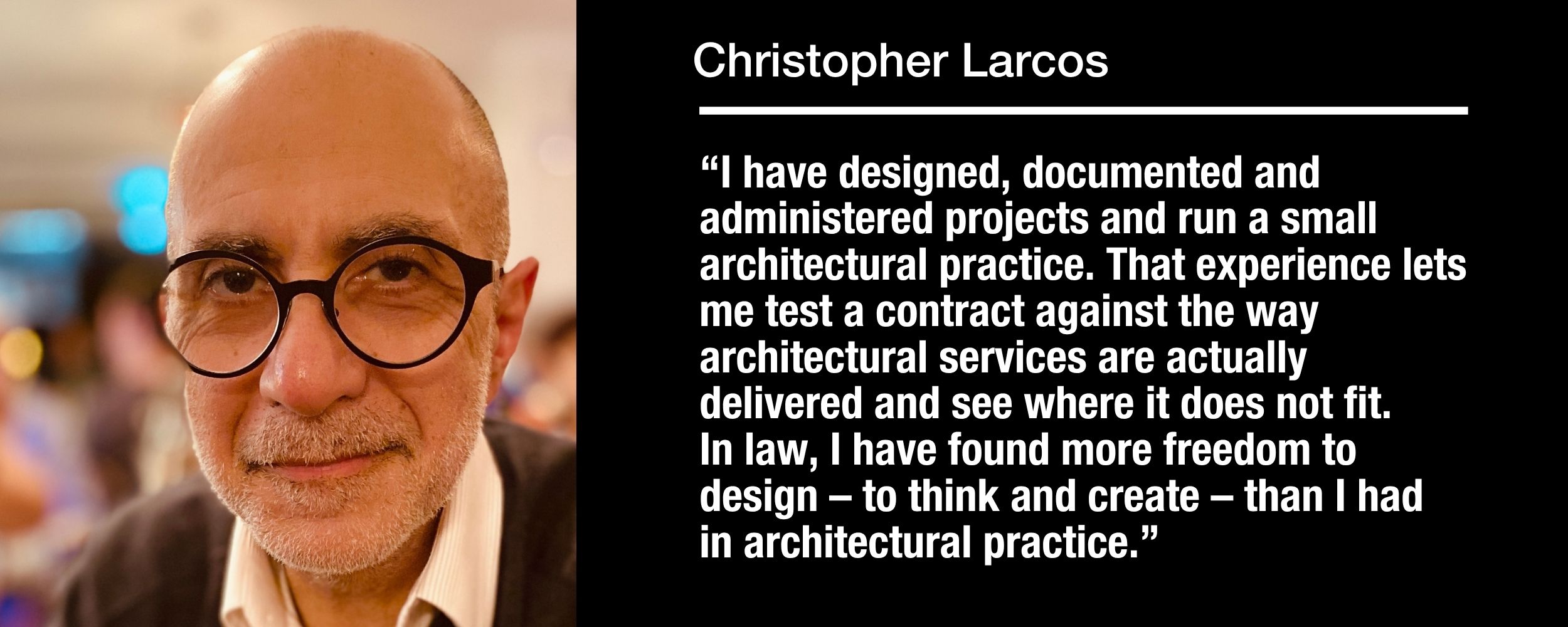
I have designed, documented and administered projects and run a small architectural practice. That experience lets me test a contract against the way architectural services are actually delivered and see where it does not fit. In law, I have found more freedom to design – to think and create – than I had in architectural practice.
My method remains the same. In architecture, I documented what was necessary and no more. In law, I try to say what needs to be said, draft what needs to be drafted, and stop. Design remains an exercise in doing the least necessary – not the bare minimum, but knowing what is essential.
That puts me somewhat at odds with conventional legal drafting, where the instinct is often to add words. I prefer fewer words, even though deciding what can safely be left out takes time and judgment.
Looking to the future, what key advice would you give to practice owners in relation to the law?
My advice is neither novel nor likely to become obsolete: keep clear contemporaneous records.
Record instructions, changes in scope, reasons for decisions, warnings, delays and their consequences for time and fees. After an important conversation or meeting, send a short email recording what was discussed and agreed. Do it while events are fresh, and store it where you can find it.
Good records expose misunderstandings while there is still time to correct them. If something matters, write it down while everyone still agrees about what happened.
Christopher Larcos, principal of Larcos Law, is a registered architect, construction lawyer and statutory adjudicator. He has more than 20 years’ experience in architectural practice and almost 25 in construction law. His longstanding contribution to the profession has included work with the Australian Institute of Architects’ Practice Committee and Senior Counsellor Service, and teaching and presenting CPD through the Institute and its regional practice networks. His work with the ACA includes advising members through the ACA Legal Advisory and drafting the ACA Short Form Client Architect Agreement, including its Victorian version.