QLD/NT President’s comment – July 2026
Six months into 2026, the challenges identified at the close of last year remain firmly in view, writes ACA QLD/NT Branch President Brett Hudson. ACA Pulse Check results confirm that practices across Queensland and the Northern Territory continue to navigate fee pressure, contractual risk and workforce challenges in an increasingly complex operating environment. The ACA has responded with practical support for members through targeted advocacy, professional engagement and stronger connections across the profession.
At the close of 2025, Brett Hudson identified three forces shaping practice across Queensland and the Northern Territory: tightening pipelines, growing contractual and financial risk, and the escalating need for stronger and more resilient business systems.
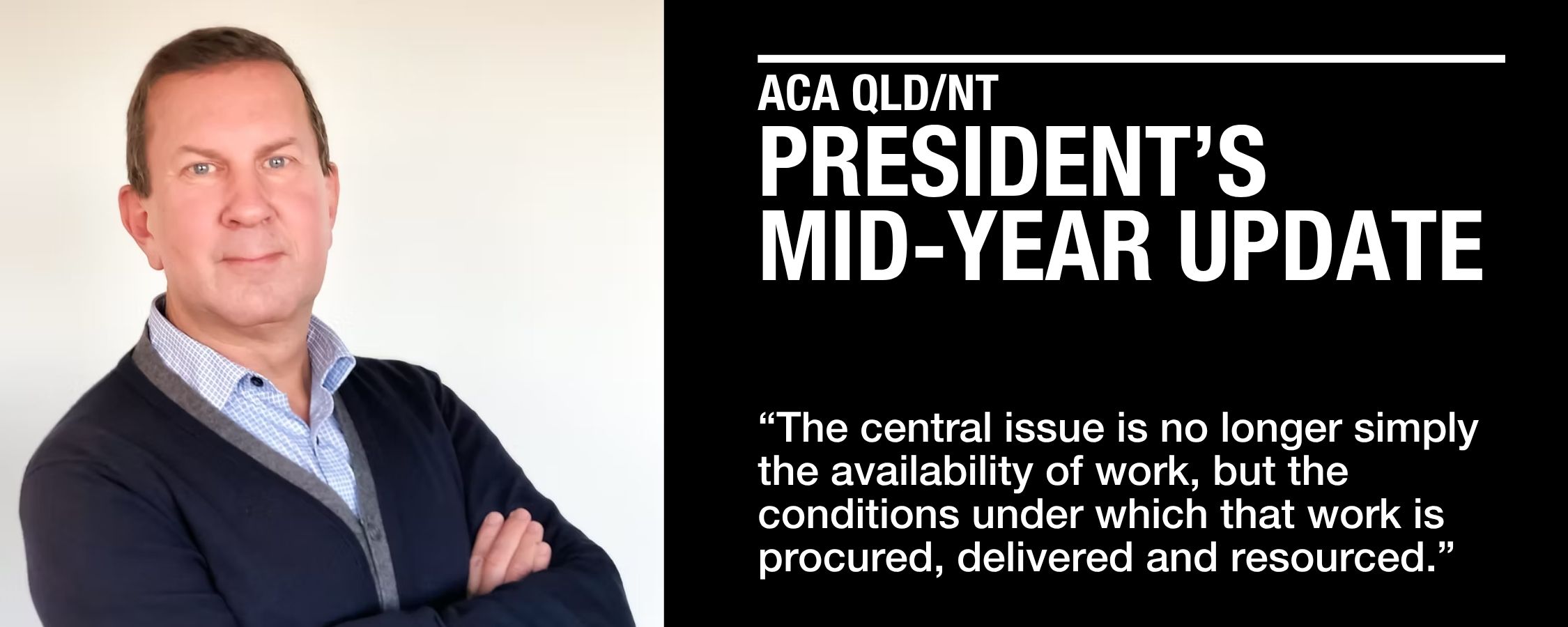
Six months on and corroborated by our Pulse Check Results, those pressures persist. Practices continue to operate in a difficult environment marked by cautious clients, competitive fee pressure, increasing contractual complexity, and ongoing challenges in attracting, training and retaining skilled people. For many architectural businesses, particularly small, medium and regional practices, the central issue is no longer simply the availability of work, but the conditions under which that work is procured, delivered and resourced.
The first half of 2026 has been defined by the ACA QLD/NT’s response to this environment: a formal advocacy structure now meeting regularly, a busy and varied events program, and a deeper investment in profiling the people and practices that make up the membership. Collectively, these initiatives translate a complex operating environment into practical support for members.
Advocacy
Advocacy stepped up in scale and structure this year with the establishment of the ACA QLD/NT Advocacy Subcommittee, which held its inaugural meeting in May. Supported by practitioners from across the state, it gives the branch a dedicated forum to set priorities, allocate work, and engage government and industry with a coordinated voice.
Drawing on the March 2026 Survey Report, the Subcommittee selected three advocacy priorities, organised across procurement, an industry reference group, and insurance and practice risk. The Queensland Procurement Policy 2026 submission is the procurement stream’s priority deliverable.
To equip members directly, the branch published two practical resources on QPP 2026. The first explains what the policy means for practices: the new whole-of-government target for procurement spend with SMEs, the requirement to provide a genuine opportunity to compete, the principle that procurement effort must be proportionate to risk and value, and the position that value for money is not the lowest fee. The second, “How to push back on bad tenders”, gives members policy-anchored language to raise concerns about poorly structured tenders, with model wording for short timeframes, disproportionate documentation, fee-driven evaluation and ambiguous scope.
The branch also contributed strongly to national ACA advocacy on architectural education, students and graduates, supervised practice and registration pathways. This included input to the Senate inquiry into Australian university graduates, reinforcing the hidden cost borne by practices in training, mentoring and supporting graduates as they move into professional practice. The ACA’s position is not that universities are failing or that practices are unwilling to support emerging professionals, but that the whole pipeline is under-resourced. The expectations on practices continue to grow, yet this work is rarely recognised in procurement, fees or business models. The branch maintains that a sustainable profession requires a sustainable pathway into practice.
Separately, the branch contributed to national work on mutual recognition and professional mobility, including matters raised through Federal Treasury. For practices operating across jurisdictions, the administrative burden and inconsistency of registration systems remains a real business issue. The ACA continues to support improvements that maintain professional standards while reducing unnecessary duplication, cost and complexity.
The branch also maintained regular dialogue with the Board of Architects of Queensland and the Australian Institute of Architects, an important forum for raising member concerns, sharing perspectives on registration and professional standards, and identifying where the ACA, BOAQ and AIA can work constructively together, particularly as the pressures on practice, education and regulation become increasingly connected.
Read the practical resources here:
Queensland Procurement Policy 2026
How to push back on bad tenders
Events
The branch’s events program has remained active and varied through the first half of the year, focusing on practical business knowledge, risk management, employment issues, procurement, practice resilience and the realities of running architectural businesses in a changing market. These sessions are an important part of the ACA’s value to members, both for the information shared and for the chance they create for practice leaders to compare experiences, test assumptions and build stronger professional networks.
In March, the ACA hosted Give to Gain, an intimate International Women’s Day lunch in South Brisbane. The boardroom-style luncheon brought together three design professionals at different career stages to reflect on where they choose to give their energy, time and care, and the trade-offs that follow. The panel featured Erin McDonald, Associate Director at Blaklash and Chair of Indigenous Architecture and Design Australia; Leone Lorrimer, executive leader and long-standing advocate for gender equity in architecture; and Eloise Atkinson LFRAIA, whose work in affordable housing advances equity through the built environment. The event was proudly supported by Stratco Architectural Solutions.
Later in March, the Business of Small Practice program presented Draw Your Why: Design Your Way to a Meaningful Life in Architecture with Rachael Bernstone of Sounds Like Design. Through guided reflection, practical tools and drawing exercises, the session helped architects reconnect with their purpose and align it with their practice and project goals. Members also toured the Mater Hospital Springfield Stage 2 Redevelopment, a significant new clinical services building in Brisbane’s western corridor. Designed by Peddle Thorp Architects and built by John Holland Group under a $1 billion, ten-year partnership with the Queensland Government, the expansion spans approximately 40,000 square metres across nine levels and delivers a new emergency department, intensive care unit, outpatient department and maternity services.
Check out the ACA QLD/NT’s upcoming events here.
Inside Practice profiles
This year, as part of our national Inside Practice series, we profiled three QLD/NT committee members, giving an honest look at how they lead, grow and take ownership of their practices.
In Leadership by Design, Rebecca Caldwell, Director, Maytree Studios, reflects on designing a practice as carefully as a project through a nine-day fortnight and a no-overtime culture. In Growth with Intention, Cara Phillips explores how to grow a studio without losing its culture, and the executive decisions that keep a practice agile at scale. In Pathway to Ownership, Justine Ezbery shares her route into practice ownership and the lessons learned along the way. Together the profiles surface the business, leadership and wellbeing questions at the heart of contemporary practice.
Looking ahead
The second half of the year builds on this foundation. The branch will host a panel for World Architecture Day Panel in October and a further Business of Small Practice session. We will also launch Business Matters, a new webinar series examining the most important issues affecting the business of architecture in Queensland today. Designed as a hybrid breakfast panel and webinar, the series brings practitioners and allied professionals together to share how different firms are navigating shared pressures, with proposed topics spanning AI in practice, QPP 2026, insurance and practice risk, and fee sustainability.
Advocacy will remain central. The Subcommittee will progress the Government Architect briefing paper, advance the QPP 2026 submission, and continue its engagement on the Queensland Housing Code and the AIA Queensland MOU, while reaching out to members to ground this work in lived practice experience.
The goal is consistent with the one set out last year: to equip architects with the tools, clarity and support needed to operate sustainably and creatively, while strengthening the collective voice of the profession.
Our sponsors
We extend our deepest gratitude to our Corporate Partners for their ongoing support. Their commitment to the profession enables the branch to host valuable events and foster collaboration across the membership, and we value their investment in the community.